Introduction
All revolutions in the world have influenced each other (Zedong, 1975: 314Zedong, M. (1975). Selected Works of Mao Tse-tung Volume: 1, Beijing: Foreign Languages Press, 1975.). This also occurred between the Turkish Revolution and the Chinese Revolution. The success of the Turkish Revolution was a source of hope and a model for all oppressed nations. The cadres of the 1911 Chinese Revolution and the early cadres of the Communist Party of China (CPC) were especially interested in the Turkish Revolution (Demircan & Zhangxu, 2023Demircan, N. & Zhangxu, Y. (2023). An analysis on Cai Hesen’s Türkiye writings. Belt & Road Initiative Quarterly, 4(4), 46-66.; Akalın, 2023Akalın, C. (2023). Turkish Revolution that Shook the World. BRIQ Belt and Road Initiative Quarterly, 4(4), pp. 6-27.). Underlying this interest was the War of Independence against imperialism led by Mustafa Kemal Atatürk and the achievement of full economic and political independence through the Republican Revolution. Following the occupation of Istanbul, the capital of the Ottoman Empire, after the First World War, Ankara, became a new center in Türkiye’s struggle for independence. After the victory in the War of Independence, Ankara became the capital of Türkiye.
On July 7, 1937, Japan moved to invade China, and an all-out resistance to Japanese aggression erupted. When the Sino-Japanese War could not be ended quickly, the Nationalist Government accepted the reality of preparing for a long-term war of resistance and had to reorganize its war strategies. On November 20, 1937, Lin Sen and his delegation arrived in Hankou and, as Chairman of the Nationalist Government, issued the “Declaration of the Relocation of the Nationalist Government to Chongqing”, announcing the relocation of the capital to Chongqing. On December 1, 1937, the National Government officially began to operate in Chongqing.
The Chinese resistance to Japanese imperialism during the Second Sino-Japanese War drew an analogy between the move of the capital to Chongqing after the fall of Nanjing and Türkiye’s move of the capital to Ankara after the occupation of Istanbul. Articles titled “Chongqing is our Ankara!”2, “China’s Ankara”3,“Panoramic view of China’s Ankara”⁴, “Best wishes to China’s Ankara”⁵, “Sichuan is China’s Ankara”⁶, “Discussion on China’s Ankara”⁷ and “Yunnan is China’s Ankara”⁸ were written in various Chinese newspapers between 1937 and 1939. The treatment of the provisional capital, Chongqing, as the “Ankara of China” turned Ankara into an inspirational symbol in the eyes of the Chinese.
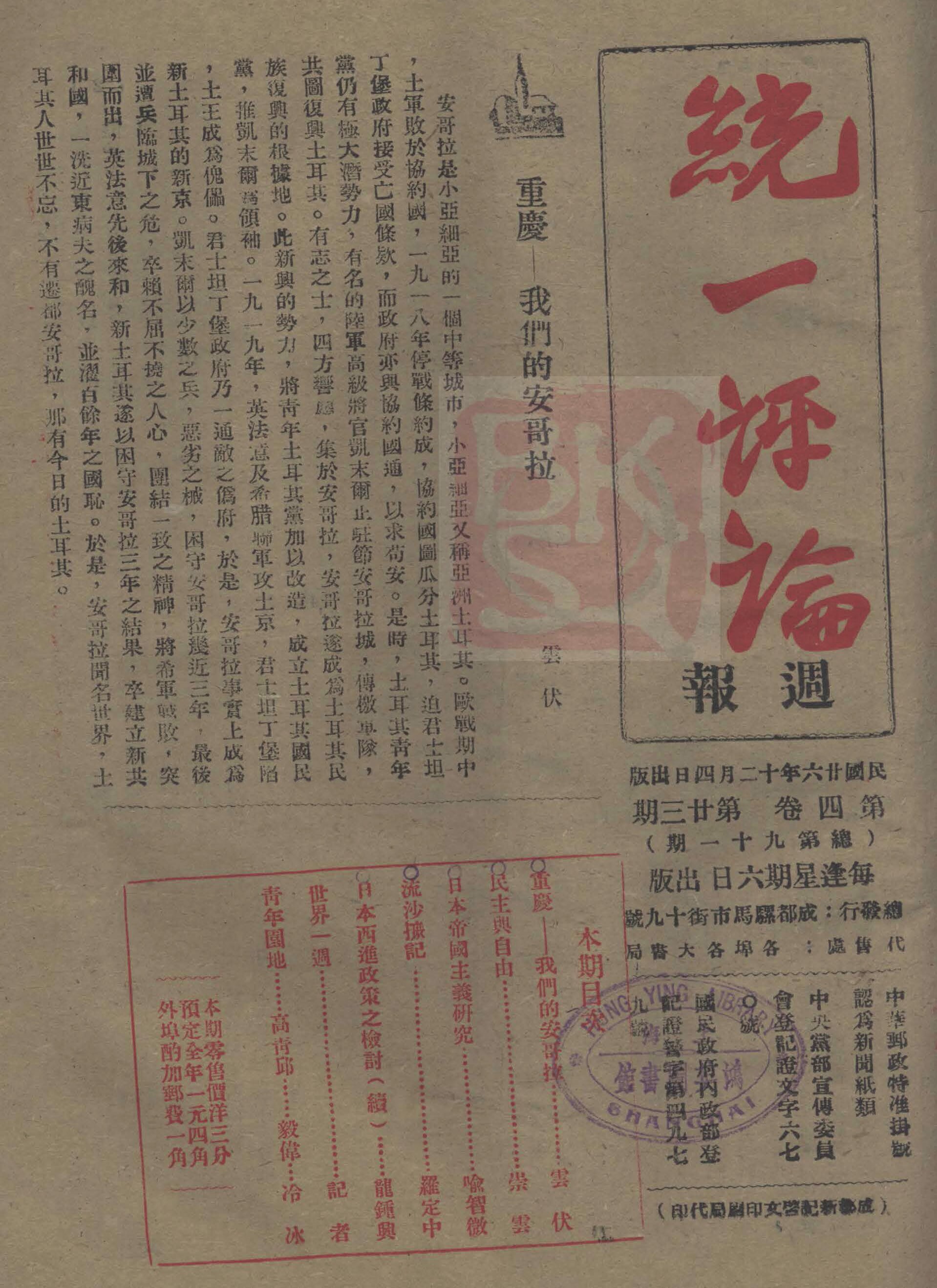
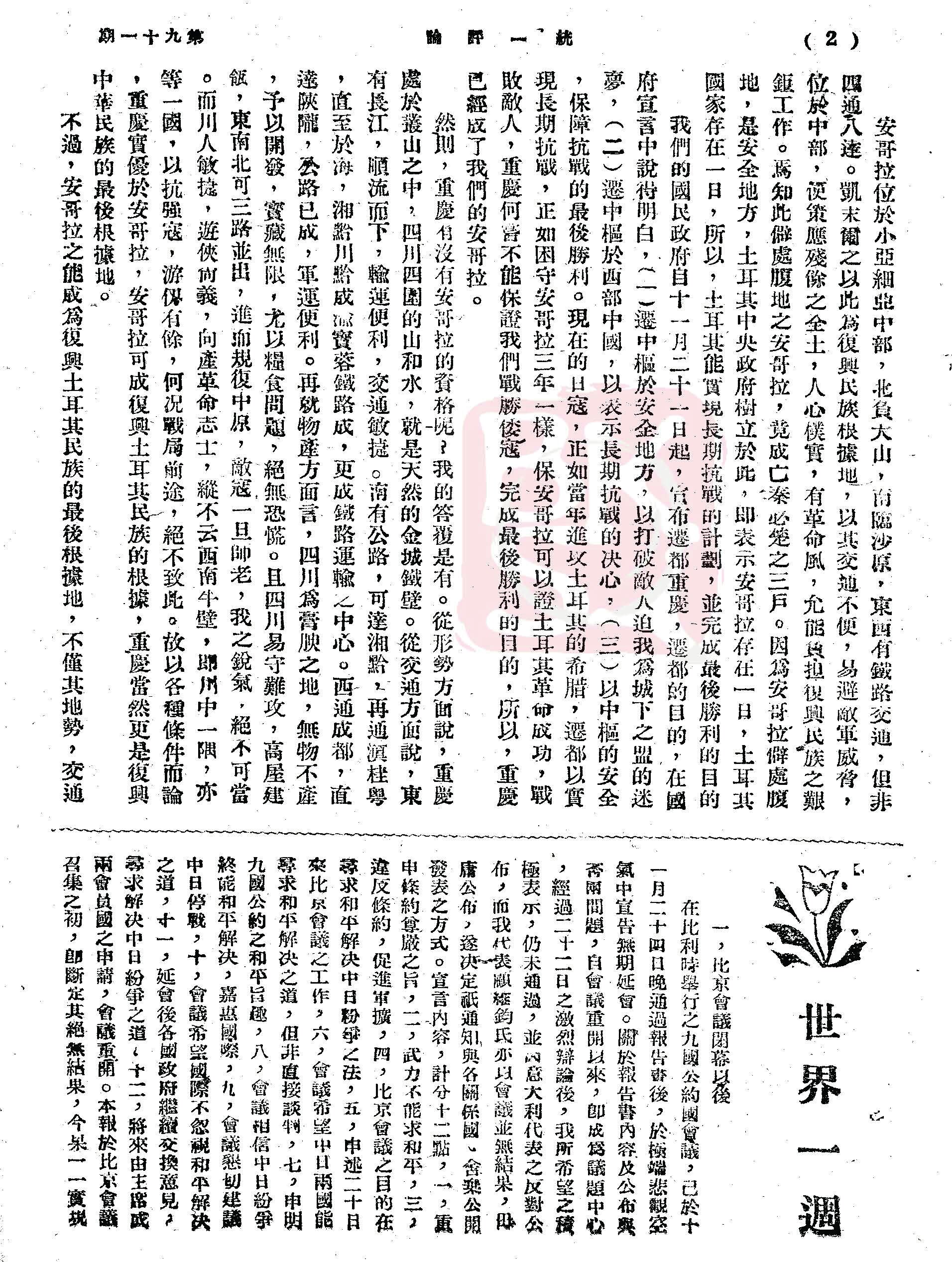
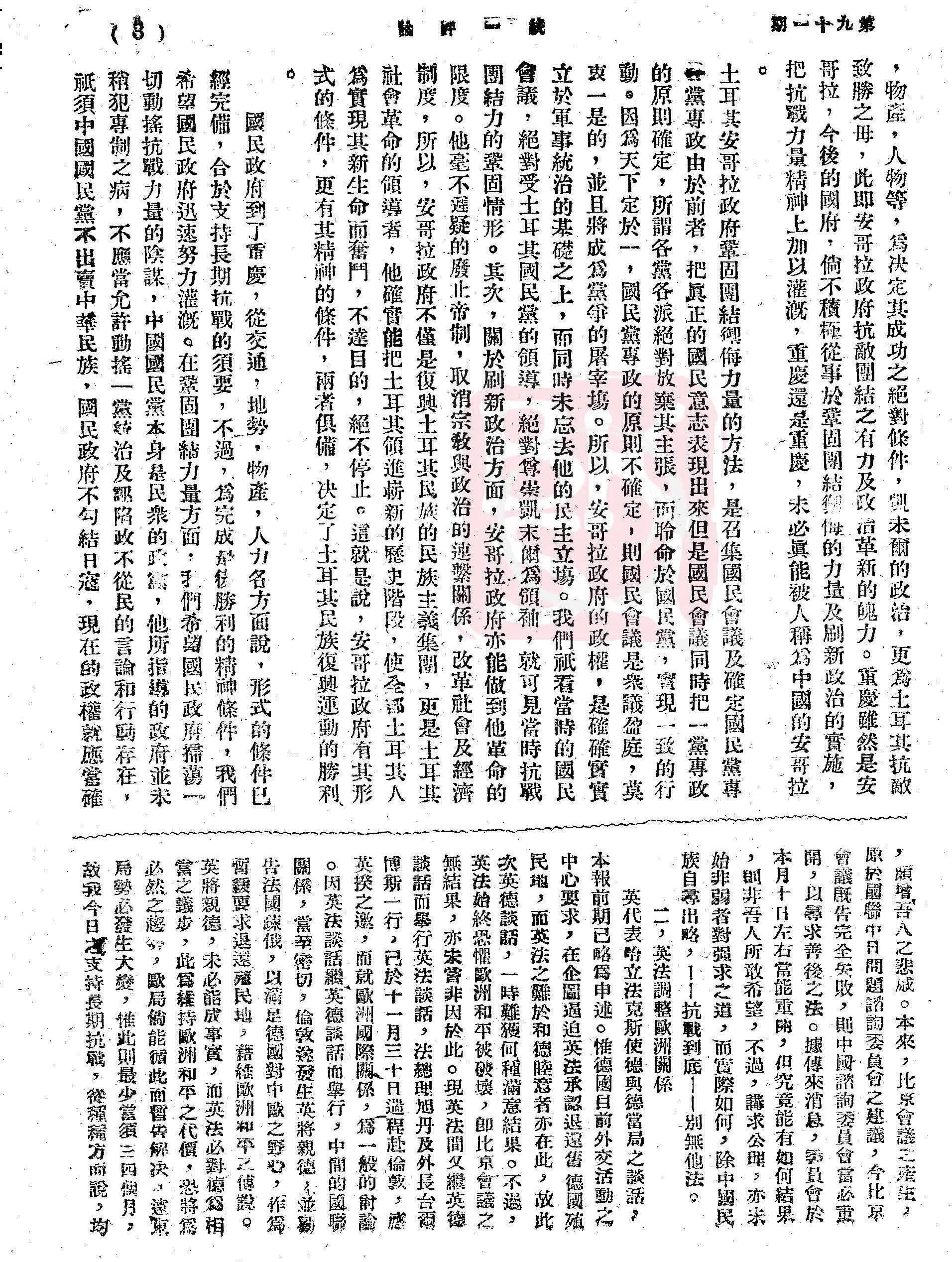
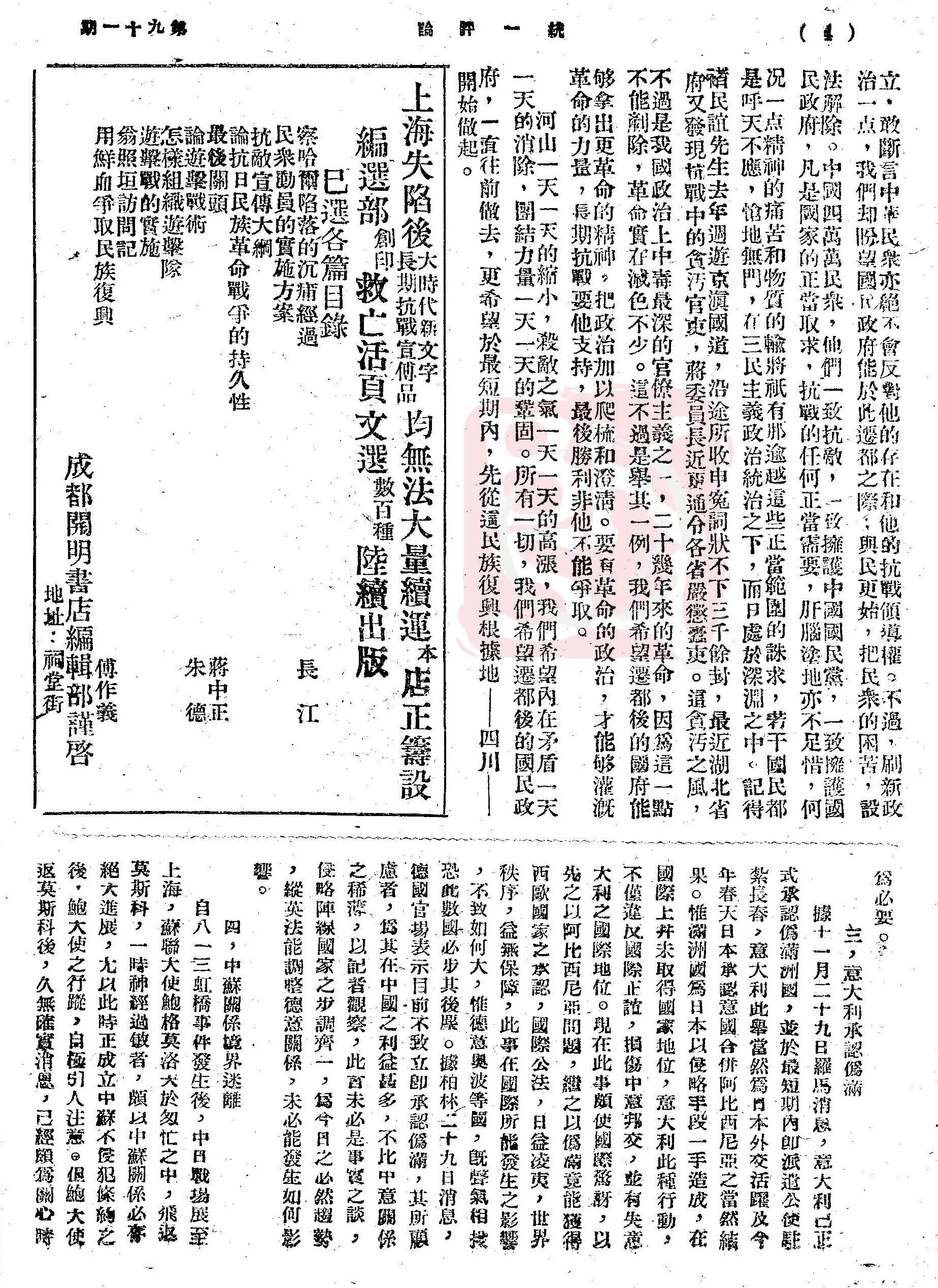
On December 4, 1937, just two weeks after the Guomindang government announced on November 21, 1937, that it had moved its capital to Chongqing, Yun Fu, editor of the journal United Review ( 统一评论 ), wrote an article titled “Chongqing is Our Ankara!”. In this respect, at a time when government officials were flocking to Chongqing, the author’s feelings and belief in victory, which he likened to Ankara during the War of Independence, were strong. The author compared the geographical and strategic position of Chongqing with the conditions of Ankara. He emphasized that Chongqing, like Ankara, was a difficult city for the enemy to reach but an easy city in terms of protection and transportation (Fu, 1937Yun Fu, (December 4, 1937). “重庆: 我们的安哥拉 (Chongqing: Our Ankara)”, 统一评论周报 (Tongyi Pinglun Zhoubao) [United Review Weekly], Issue 4, No. 23, pp.1-4.; Kalkan & Fidan, 2023Kalkan Ç. M. & Fidan G. (November 1 2023): Ankara in Chinese Imagination: Turkish Capital and Its Influence on ‘Temporary Capital’ Chongqing, The International History Review).
There were two reasons behind the Chinese identification of Chongqing as the capital with Ankara. Firstly, the interest of Chinese progressives in the Turkish Revolution turned into sympathy. Secondly, Türkiye stood by China in its difficult times. On May 16, 1935, China opened its first embassy in Türkiye, which played a positive role in developing bilateral relations. Then, despite the war conditions in China, Türkiye opened an embassy building in Chongqing. Türkiye’s envoy (Turkish: Orta elçi), Emin Ali Sipahi, arrived in Chongqing on December 21, 1939, and started his duty by presenting his credentials (BCA, 1940BCA. (February 20, 1940). Fon 30-10-0-0, Yer no: 257-728-15.; TDA, 1939Turkish Diplomatic Archive (TDA). (December, 1939). Fon: 515-7484 Yer no: 43178-3 Emin Ali Sipahi`s presentation of his credentials.; Hong Kong Herald, 1939Hong Kong Herald. (December 28, 1939) Turkish Minister to China Presents his Credentials, pp.3.). Türkiye’s diplomatic mission in Chongqing, which was closed in 1931 due to economic problems, was reopened after a gap of 8 years and upgraded to an embassy.
The United Review ( 统一评论 )⁹
The United Review was a political journal edited by Zhang Yunfu ( 张云伏 ) and published by the United Review Press, which was founded in Chengdu in November 1935 and ceased publication in November 1939. At the time, China was divided into different regional administrations in political chaos (CN- BKSY, 2024CN- BKSY (2024). The source article does not provide a separate full bibliographic entry for this citation.). The weekly United Review was on a mission to reunite a warlord-ridden and politically divided China. This approach parallels Türkiye’s policy of uniting all sectors against imperialism during the War of Independence.
Advocating Sun Yat-sen’s Three People’s Principles, the magazine published reports on current events, political and economic situations, border issues, and academic research on ancient figures and events. The weekly magazine included columns such as Border Issues, Academic Research, Current Events Commentary, Short Commentary, Youth Forum, Conference Theater, World Week, Eastern Scale, Western Claw, Opinion Collection, Youth Corner, and more (CNBKSY, 2024CNBKSY (2024). The source article does not provide a separate full bibliographic entry for this citation.).
Among the main articles published in the journal were “How to deal with the aggression of Japanese imperialism?”, “The political system China needs”, “The Gongsun clan in Liaodong at the end of the Han Dynasty and the beginning of the Wei Dynasty”, “International economic struggle and the Chinese Revolution”, “The political geography of Britain, France and Italy in the Mediterranean”, “The revival of the countryside and the cooperative movement”, “Border problems: A study on Songpan”, ‘How to build a psychological national defense’, ‘World cultures and Chinese culture’, ‘The past, present and future of the Sichuan Rural Construction Institute’ and ‘The past, present and future of the Sichuan Rural Construction Academy’ and ‘The Japanese Renovation Movement’. Ankara10 is a medium-sized city in Asia Minor, also known as Asian Türkiye. During World War I11, Türkiye was defeated by the Allies and reached an armistice treaty in 1918. The Allied Powers carved up Türkiye and forced the Istanbul12 (Ottoman) government to accept the terms of subjugation. The government also colluded with the Allied Powers to seek momentary ease with no thought of the future. At that time, the Young Turks still had great potential. The famous senior army general, Mustafa Kemal13, was stationed in Ankara and issued a recruitment notice in an attempt to revive Türkiye. People with lofty ideals responded from all sides and gathered in Ankara. Ankara became the base of Turkish national rejuvenation. This emerging force transformed (reformed) the Young Turks, established the Turkish National Party1⁴ and elected Mustafa Kemal as its leader.
In 1919, the British, French, Italian and Greek forces attacked the Turkish capital. Istanbul fell, and the Sultan became a puppet. The government of Istanbul was a puppet government that collaborated with the enemy, so Ankara became the new capital of the new Türkiye. With a small number of soldiers and poor weapons, Mustafa Kemal was trapped in Ankara for nearly three years. In the end, the city was under siege. However, thanks to his unyielding heart and spirit of unity, he defeated the Greek army and broke out. As a result, Britain, France and Italy came to make peace with Türkiye. New Türkiye only established a new republic after being trapped in Ankara for three years, erasing the ugly name of the Sick Man of the Near East and the national humiliation of more than a hundred years. Therefore, Ankara became famous worldwide, and Turkish people will never forget it. Without moving the capital to Ankara, there would be no Türkiye today.
Ankara is in the middle of Asia Minor, with mountains to the north and sandy plains. It has railway transportation from east to west but is not well connected in all directions. Mustafa Kemal chose this place as a base for reviving the nation because it had inconvenient transportation and could easily avoid enemy threats. At the same time, it is located in the center so that it can control the rest of Türkiye. The people here are simple in heart, have a revolutionary style, and can undertake the arduous work of rejuvenating the nation. Who knew that in a remote hinterland like Ankara, so many people would die because of the revolution? Because Ankara is located in the remote hinterland, it is a safe place. Establishing the Turkish central government here means that Ankara and the Turkish state will exist. Therefore, Türkiye can realize its long-term war plan and achieve its goal of final victory.
Chongqing - our Ankara 重庆: 我们的安哥拉 统一评论周报 Yun Fu, (1937)
Our National Government has announced that it will move the capital to Chongqing on November 21. The purpose of moving the capital is clearly stated in the National Government Declaration.
(1) Move the capital to a safe place to break the enemy’s dream of forcing us to sign a treaty under coercion.
(2) Move the capital to western China to show Chinese determination to resist the war for a long time.
(3) Use the security of the capital to ensure the victory of the war of resistance. Today’s Japanese invaders are just like the Greeks who attacked Türkiye and moved their capital to achieve a long-term war of resistance. Just like they were trapped in Ankara for three years, protecting Ankara can prove the success of the Turkish revolution and defeat the enemy. Why couldn’t Chongqing prove our victory over the Japanese pirates and achieve the goal of final victory? Therefore, Chongqing has become our Ankara.
However, does Chongqing have the qualifications to become Ankara? My answer is yes. In terms of location, Chongqing is located among mountains, and the mountains and rivers surrounding Sichuan are natural barriers. In terms of transportation, there is the Yangtze River in the east, and the transportation is convenient and fast. A highway in the south can reach Hunan and Guizhou, then connect to Yunnan, Guangxi and Guangdong until it reaches the sea. When the Hunan-Guizhou-Sichuan-Guizhou-Chongqing-Chengdu Railway is completed, it will become the center of railway transportation. It connects to Chengdu in the west and directly to Shaanxi and Gansu. The highway has been completed, and military transportation is convenient.
In terms of products, Sichuan is a fertile land. It produces everything, and if it is developed, it has unlimited reserves. Especially when it comes to food issues, there is no panic. Moreover, Sichuan is easy to hold but hard to attack. It is well-positioned on high ground. It can advance in three directions from the east, south, and north and restore the Central Plains. Once the Japanese enemy’s morale is low, the vigor of our soldiers will never be stopped. The people of Sichuan are agile, adventurous, and righteous, and they have always had many revolutionary martyrs. Not to mention the southwestern half of the wall; just a corner of Sichuan is equivalent to a country that can resist strong pirates.
Moreover, the future of the war will never come to this. Therefore, in terms of various conditions, Chongqing is better than Ankara. Ankara can become the basis for rejuvenating the Turkish nation, and Chongqing is certainly the last base for rejuvenating the Chinese nation.
However, Ankara can become the final base for the rejuvenation of the Turkish nation. Its terrain, transportation, products, and tasks are not only the absolute conditions that determine its success. At the same time, Mustafa Kemal’s politics are the mother of Türkiye’s victory against the enemy, which is the Ankara government’s courage to unite the power to resist the enemy and carry out political innovation. Although Chongqing is compared to Ankara, if the future National Government does not actively engage in consolidating the power of unity to resist aggression, implement reform politics, and spiritually irrigate the anti-war forces, Chongqing will still be Chongqing, and it may not be called China’s Ankara.
The Turkish government in Ankara’s method of consolidating and uniting its forces to resist aggression was to convene the National Assembly and determine the National Party’s single-party rule to demonstrate the true will of the people. However, the National Assembly also determined the principle of one-party dictatorship: each party would give up its advocate and take orders from the National Party to achieve unified action. Because all under heaven submit to one ruler, if the principles of the National Party’s dictatorship were uncertain, the National Assembly would be filled with disagreements and become a slaughterhouse for party disputes. Therefore, the Ankara government’s regime was indeed based on military rule, while at the same time, it had not forgotten its democratic stance.
If we only look at the National Assembly at that time, it was under the leadership of the Turkish Nationalist Party. It respected Mustafa Kemal as its leader, which showed the consolidation of the anti-war unity at that time. Secondly, the Ankara government can achieve its revolutionary limits regarding political reform. They did not hesitate to abolish the monarchy, cancel the relationship between religion and politics, and reform the social and economic system. Therefore, the Ankara government was not only a nationalist group that revitalized the Turkish nation but also the leader of the Turkish social revolution. It will certainly lead Türkiye into a new historical stage and enable all Turks to strive for their new lives. If they fail to achieve their goals, they will never stop. That is to say, the Ankara government has its own form and spirit. Both of them determine the victory of the Turkish national rejuvenation movement.
The Nationalist government moved to Chongqing, and in terms of transportation, terrain, resources, and manpower, the formal conditions were already complete, which met the needs of supporting the long-term resistance. To achieve the spiritual conditions for ultimate victory, we hope that the Nationalist government will quickly work hard to irrigate. In consolidating unity and strength, we hope the Nationalist government will sweep away all conspiracies that undermine the anti-Japanese forces. The Kuomintang itself is a political party of the people, and the government it guides has not committed any tyranny. We should not allow any remarks or actions that undermine the rule of one party or falsely accuse the government of not obeying the people to exist. As long as the Kuomintang does not betray the Chinese nation and the Nationalist government does not collude with the Japanese invaders, the current political power should be supported. I dare assert that the Chinese people will not oppose his existence and leadership in the anti-Japanese war. However, in terms of refreshing politics, we hope the Nationalist government can start anew with the people and find ways to alleviate their suffering during this capital relocation. Four hundred million Chinese people unanimously resist the enemy, support the Kuomintang, and support the Nationalist government. They are willing to pay for any legitimate demands of the country and legitimate needs of the anti-Japanese war.
Moreover, a little spiritual pain and material loss can only be achieved through demands beyond these limits. Many citizens cannot respond, with no way out, and under the political rule of the Three Principles of the People, they are constantly in the abyss. I remember Mr Zhuminyi traveling around the Beijing Yunnan (Jing-Dian) National Highway last year and receiving over 3000 complaints along the way. Recently, the Hubei Provincial Government discovered corrupt officials during the anti-Japanese war, and Chairman Jiang recently ordered all provinces to punish corrupt officials severely. This corruption culture is just one of the most toxic bureaucratism in our country’s politics. The revolution of more than 20 years has been greatly reduced because it cannot be eradicated.
This was just one example. After moving the capital, we hope that the National Government can show a more revolutionary spirit and sort out and clarify politics. Only with revolutionary politics can we irrigate the power of revolution. In the long-term war of resistance, we need his support, and in the end, victory cannot be achieved without him. The territory is shrinking daily, and the desire to kill the enemy is rising daily. We hope that the internal contradictions will be eliminated daily and the strength of unity will be consolidated daily. In all of this, we hope that the National Government will continue to move forward after moving the capital, and we hope that in the short term, we will start from Sichuan15, the base for national rejuvenation.