Introduction
Currently, the center of weight of production has transitioned from the West to the East. Since the 1990s, this process has intensified, coinciding with the shift of our globe from unipolarity to multipolarity. The conflict between the Atlantic System, spearheaded by the USA, and the Oppressed-Developing World continues to sharpen across military, economic, political, and ideological dimensions. This process has caused the deepest rifts within the United States since the American Civil War. The issue extends beyond the mere relocation of the center of industry on Earth. The Developing World, which got born from within the Oppressed World, is now spearheading the formation of a novel social system that offers alternatives to the imperialist framework throughout all facets of life. The current phenomenon is the emergence of a novel civilization from Asia, representing oppressed nations. Consequently, the matter represents an existential challenge to the imperialist system. Furthermore, the emerging civilization represents a potential initial phase toward a classless society in which all forms of exploitation are to be eliminated.
New civilizations emerge from revolutions that fundamentally alter all facets of life. The construction and growth of a new socio-economic order are contingent upon the adoption of a new value system. A revolution cannot occur without embodying a novel worldview, or, in other terms, there is no revolution devoid of philosophical underpinnings. Science and art hold a pivotal position in this new value system, alongside philosophy.
Similar to all natural processes, historical processes necessitate an energy source. Humans are the source of energy in history. Human energy is therefore the most significant form of energy in terms of social development. The assessment of a social system’s advancement is its capacity to uncover and harness the latent potential of society. An obsolete system, having depleted all its contributions to human advancement, focuses solely on preserving its supremacy by perpetuating the status quo, so attempting to suppress social dynamism. It seeks to marginalize the human source of energy, relegating them to the perimeter of society rather than positioning them at the core of life. The prevalent characteristic of emerging civilizations throughout history has been their capacity to relocate humanity to the center of life. For the emergence of a new civilization requires the transformation of social life. To do this, societal energy must be unleashed and channeled towards appropriate objectives.
The primary catalyst for energizing a human being is the aspiration to construct the future. The more luminous the future to be constructed, the more intense this aspiration grows. As the pathway to constructing the future becomes more evident, human cognitive and emotional capacities increasingly concentrate on the objective. Future construction knowledge is acquired through scientific inquiry. Science is for constructing the future. On the other hand, it is enthusiasm that empowers an individual to release her full potential. Art, by eliciting this enthusiasm, fortifies the resolve to construct the future. Consequently, science and art have a pivotal role among the essential instruments of the revolution.
When the social system becomes reactionary and impedes social progress, science, art, and philosophy do not vanish. Their content and scope are transformed. Science is marginalized from the core of life and relegated to a technical endeavor that upholds the reactionary system. Art is converted into an instrument for depriving enthusiasm of its social content. Novel and artificial environments are established on the peripheries of the society, allowing individuals to withdraw into isolated cells and encounter illusory thrills. Philosophy aims to separate the present from the future. In conclusion, science, art, and philosophy emphasize the perception of life as a phenomenon solely limited to the individual and the present moment. The social deterioration observed throughout the decline of every civilization in history has become a prevalent consequence of this approach.
In history it has not been seen that the shell knit on science, art, and philosophy by a declining civilization is broken from within that civilization. The place, where a declining civilization is strongest, is its own epicenter. The shell has consistently been fractured and transcended by rising societies in the periphery, especially those that have relatively most thoroughly assimilated the accomplishments of the past. Because the social energy essential to breach this shell occurs in cultures that are focused on constructing the future, not in those where development is inhibited.
Currently, humanity is experiencing a transformative process in which the epicenter of civilization is relocating. The change in the center of production marks a front step, while the advent of a new civilization from Asia taking the lead in science, art, and philosophy worldwide will mark a key step in this process.
The neoliberal paradigm concerning science and technology
To effectively formulate a plan for the emerging civilization from Asia in science and technology, it is essential to comprehend the capitalist-imperialist system’s perspective on these domains. Since the 1970s, neoliberalism has characterized the imperialist system. The 1970s signify a pivotal moment regarding the strategy employed by this system in the realm of science and technology as well.
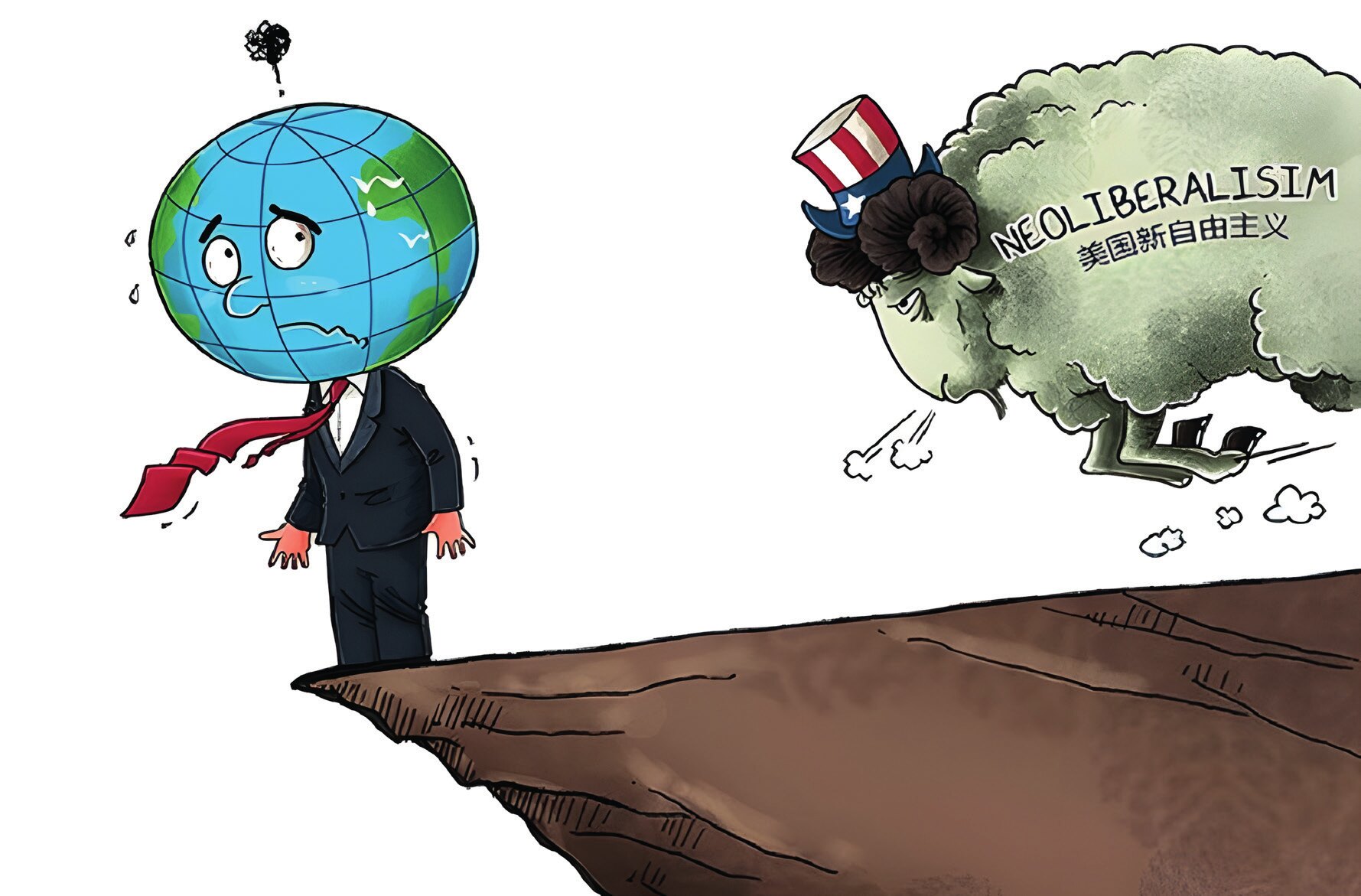
Currently, the paradigm of neoliberalism’s “Information Age” directs scientific and technological advancements in the West. This strategy, not confined to the West, continues to exert a substantial influence on the global landscape. Moreover, science and technology constitute one of the most significant areas of competition between the global East-South and the imperialist West-North today.
According to the neoliberal program, economic progress should be totally entrusted to the guidance of capitalist markets. However, the market is incapable of handling public goods. The objective of neoliberalism can alone be realized in a context where all entities are converted into “private goods”. Privatization is thus a fundamental notion of neoliberalism.
Markets are unable to internalize indirect returns that extend beyond the short term. To put it another way, markets are myopic. Thus, when economic progress is totally left to the markets, the medium and long term evaporate, and immediate and direct returns become the dominant measure of efficiency.
The meaning that neoliberalism attaches to “information” within the framework of the “Information Age” has been correspondingly shaped. Acceptable information is defined as that which can be promptly transformed into financial, military, or political power. The generation of information with indirect returns or delayed outcomes is deemed unacceptable, as no economic agent is prepared to bear the “storage costs”. This approach transforms information from a public good into a private good created for exchange, allowing market forces to dictate the evolution of knowledge creation. Consequently, science and scientific organizations are included in privatization.
Privatizing the economies of emerging nations and incorporating them into the capitalist global market subjects them to the prevailing imperialist system. Delegating development direction to market spontaneity precludes these countries from formulating a development strategy tailored to their unique circumstances. Consequently, the nation-states of developing countries are diminished to ineffectual surveillance mechanisms. The imposition of privatization by neoliberalism seeks to “eternalize the sovereignty of the sovereign.”
The projection of the “Information Age” approach onto developing countries consists of including the fields of science and technology within the same purpose and method. However, a strategy that includes both the long and medium term in scientific and technological development is of vital importance. Leaving the development in this field to spontaneity via privatization leads to irreparable destructive effects.
İSince World War II, particularly from the 1960s onward, the world has experienced substantial technical advancements in communication, automation, and genetics. The notions of “Artificial Intelligence” and “Scientific Technological Revolution” were initially introduced in the 1960s to characterize this process.
Social revolutions constitute interventions in the production relations. The advent of private property due to the Agricultural Revolution marks a pivotal alteration in the production relations throughout human history. The Industrial Revolution, signifying the most significant advancement in production following the Agricultural Revolution, emerged from the dissolution of feudal production relations via democratic revolutions and the development of capitalism as the prevailing mode of production. The social impetus for the Scientific Revolution was provided by the proliferation of capitalist production relations. This revolution has established a radical break from the past by presenting the modern conception of science to humanity. The Scientific Revolution represents a significant triumph of materialism over idealism in the realm of philosophy.
The “Scientific Technological Revolution” is not an interference in the production relations, nor has it arisen from such an interference. Since the 1960s, substantial alterations in warfare technology, production processes, and social life have undoubtedly transpired. Today, it is indeed true that any technological advancement not grounded on scientific knowledge has become unfeasible. However, the “Scientific Technological Revolution” does not denote a scientific breakthrough; instead, it represents a technological harvest of scientific knowledge whose theoretical foundations were laid before the 1960s. Since the 1970s, fundamental sciences have progressively declined in popularity in the West. The function of the basic sciences has been diminished to addressing deficiencies that directly fulfill the demands of technological advancement. In science, the criterion for the urgency of a discipline has transitioned from pioneering new frontiers to its direct association with technology.
The United States has recognized the “Scientific and Technological Revolution” as a significant area of competitiveness with the Soviet Union. Gorbachev, in declaring the fall of the Soviet Union, ascribed it to “capitalism triumphing over the socialist system through the attainment of the Scientific and Technological Revolution.” Currently, the United States views the enhancement of its dominant and monopolistic status in sophisticated technology as a crucial element in solidifying its global hegemony. The escalation of competition in science and technology between the emerging Asian civilization and the imperialist system is attributable to this rationale. Consequently, it is crucial to comprehend the role of the “Information Age” paradigm and the “Scientific and Technological Revolution” in shaping the United States’ strategy regarding science and technology if one is to form a strategic science and technology framework for the emerging civilization in Asia.
The knowledge we have of nature represents the primary element of productive forces. The main reason humans occupy a central position in the productive forces is precisely this. However, the influence of the natural sciences on social development extends beyond their contributions to productive forces. The engagement of humans with nature also influences their perspective of the world. Throughout history, the impact of scientific breakthroughs on philosophy has occasionally gone well beyond their contribution to productive forces.
The impetus for the astronomical research underpinning the Scientific Revolution is unequivocally the demands highlighted by production and commerce. However, the genuine impact of the discovery of the movements of celestial bodies and the natural principles that govern them upon manufacture required centuries. The principal contribution of the Scientific Revolution to human advancement was the destruction of the medieval worldview. The Scientific Revolution and Humanism established the groundwork for the Enlightenment, facilitating democratic revolutions against feudalism ideologically. The bourgeoisie, having ascended to power via democratic revolutions, eliminated impediments to the proliferation of capitalist production relations, establishing capitalism as the prevailing mode of production. The thorough integration of scientific discoveries into production via technology transpired throughout the Industrial Revolution. The fact that the time it takes for scientific findings to be reflected in production has greatly shortened today is not because science has changed its character. This occurs because science has been diminished to an endeavor that generates “ready-to-receive” knowledge “on-demand” of technology.
Today, while advanced technological items are being integrated into our daily lives, we also witness a pervasive propagation of anti-science beliefs. The origin of these fallacies is neoliberalism, which is fostered by views of the Middle Ages as well. The objective of this neoliberal fallacy offensive is to suppress social dynamism, disrupt the link between science and the Enlightenment, and marginalize science in societal life, thereby inhibiting its potential as a means for constructing the future.
From World War II to the 1980s, our world underwent a phase in which states wanted independence, nations sought liberation, and peoples aspired to revolution. The revolutionary rise culminated in 1975 with the conclusive triumph of Vietnam, Laos, and Cambodia over the United States. The United States, to maintain and strengthen its global hegemony, initiated a quest for a new strategy, leading to the emergence of neoliberalism. The ideological offensive, which represents a fundamental component of the neoliberal agenda and had undergone extensive preparation in the 1970s, commenced in the 1980s and acquired additional speed in the 1990s following the disintegration of the Soviet Union.
The core of this assault involves depleting the conceptions that garnered global esteem during the revolutionary ascent, reducing them to simple packing materials refilled with a counter-revolutionary content. First and foremost, the notion of revolution has been distorted. For the past thirty years, all the colorful counter-revolutions planned around the world have been classified as “revolutions” under fancy titles. Particularly, all scientific conceptions have been subjected to this conceptual deception. In place of objective reality, each individual’s own virtual reality has been imposed. Consequently, the universal binding essence of scientific results has been nullified. Furthermore, regarding scientific results as binding for everybody has been deemed “a significant infringement of freedom,” and the equal treatment of science and anti-science arguments has been promoted under the guise of democracy. In deference to liberty and democracy, science has been reduced to a technical endeavor, whose findings are solely valid within its limited domain and thereby detached from any social context whatsoever. As several intellectuals have aptly articulated, a “New Middle Ages” has emerged. This approach signifies not a scientific revolution but an anti-scientific counter-revolution.
This counter-revolutionary ideological attack has subjected science to a twin constraint alongside privatization. These restrictions have been specifically applied to the fundamental sciences. Neither can science break free from these shackles using artificial intelligence technology, nor can it be freed of these shackles in the countries that made these shackles. The force that will facilitate the emancipation of science resides alone in the emerging civilization from Asia.
The State’s Role in Developing Science and Technology
Scientific and technological knowledge can only be established as a public asset by the state’s intervention. The assimilation of scientific and technological knowledge by the whole society will provide a substantial advantage for the rising new civilization over the imperialist-capitalist system. The conversion of information into a public asset facilitates a maximal contribution of this knowledge to enhancing productive forces.
The rationale for the privatization of knowledge in the West is that the competition it engenders will serve as the impetus for knowledge development. Success in scientific and technical research undoubtedly requires an incentive design. However, when motivation is reliant on market dynamics, the trajectory of scientific and technological advancement will accordingly be dictated by market forces. The promotion of science and technology can only occur under the state’s leadership and supervision, in alignment with the established science and technology plan.
Scientific and technological research is performed in diverse settings, including corporate R&D departments, universities, research organizations, and specialized laboratories. Consequently, it is expected that the content of incentive systems will differ based on the environment. In certain contexts, pecuniary incentives may prevail, whereas in others, the pursuit of truth or the enthusiasm for societal contribution may be more prominent. The substance of these regulations should be established by each nation in accordance with its own circumstances. As the process evolves, it is inevitable that the regulations will be modified to accommodate changing conditions. Consequently, the design of incentive mechanisms ought to be regarded as a distinct area for investigation in social sciences.
Grounding development on scientific and technical advancement necessitates an appropriate balance of collaboration and rivalry. In our world, science and art are two domains where outcomes cannot be attained through directives. Consequently, it is imperative to guarantee suitable flexibility in the operations of scientific organizations. Scientific research necessitates expansive thinking and creativity devoid of biases, as it functions at the frontier of the known and the unknown. Flexibility produces the desired outcomes only when it is supported by a robust foundation. Lacking a backbone, flexibility results in an environment whose tissue resembles that of mollusks. The backbone of this process is the science and technology strategy.
The research agenda is fundamental to science and technology policy. Every scientific discipline possesses two distinct sources for its research goal. The agenda’s external source is comprised of economic and social requirements. The internal source, on the other hand, represents the research frontier attained by the autonomous advancement of that scientific discipline. The former source is national, whereas the latter is universal. Consequently, the scientific agenda of each nation constitutes a national program that intersects with the scientific agendas of other nations.
The imperialist system contends that there is a unique agenda of science which is universal, aiming to impose its own agenda globally. In science, the yardstick of truth is testing against objective reality. This criterion is universal. The notion that scientific knowledge is a collective possession of humanity is a prerequisite for the universality of science. Neoliberalism, on the one hand, constricts the domain of objective reality by positing that each individual possesses her own reality, while on the other hand, it commodifies research, relegating scientific knowledge to a privilege accessible only to those who pay for it. In other words, neoliberalism has curtailed the genuinely universal essence of science. On the other hand, to leverage the scientific capabilities of other nations in accordance with its own objectives, neoliberalism superimposes a facade of universality on national scientific agendas and denounces the national aspect of the agenda as an undesirable form of “chauvinism”, which is unseemly for science.
The national science agenda must align with the national development strategy’s requirements. The execution of the scientific agenda necessitates thorough planning that encompasses the long- and medium-term aspects as well. Effective central planning and its efficient execution can only be realized under state leadership.
The essential factor in executing a research agenda is the development of the requisite qualified human resources. Consequently, the established science-technology plan must be complemented by a corresponding educational program. In the realm of scientific advancement, establishing procedures that facilitate talent discovery and the guidance of those identified talents is of vital importance. The general quality of education is also crucial, as it will broaden the pool from which the scientific workforce will arise. An educational plan aligned with the science and technology strategy necessitates the precise establishment of medium- and long-term objectives in advance. Education and science are the fields where errors in the strategic concentration are hardest to fix.
State leadership is essential for success; however, it is not sufficient on its own. The established plans form a framework. Realization of this framework becomes attainable by mobilizing the essential institutions and individuals within by unleashing high-quality human energy. Scientific inquiry necessitates perseverance. Science education encompasses more than only transmitting established knowledge to students. The pursuit of truth and the cultivation of a public service ethos are essential components of science education.
From the viewpoint of the Developing World, there exists no historical precedent from which a science and technology strategy may be emulated. This situation arises not only from the differing conditions of each country but also from the differing conditions of each era. In the contemporary landscape, success cannot be attained by emulating the scientific and technological trajectories of industrialized capitalist nations. Consequently, innovation, creativity, and entrepreneurship are crucial in shaping the strategy to be adopted.
In the contemporary landscape, achieving path-breaking advancements in science and technology necessitates both a proficient workforce and the creation of appropriate institutions furnished with cutting-edge technological resources and laboratories. Consequently, contemporary scientific endeavors exhibit a far more collaborative character than in previous eras. This feature further reinforces the state’s involvement in scientific and technological advancement.
Formulating the appropriate synthesis of long-term and short-term
Today, in the Developing World, security requirements, with escalating global economic competition, are compressing timelines and prioritizing short-term considerations. There is no question that time will not wait for anyone to be ready. Consequently, it is imperative to achieve a substantial amount in a limited timeframe. However, the success of the nascent civilization hinges on its capacity for medium and long-term planning and the development of requisite tools for plan execution without surrendering to the constraints of short-termism.
The effective management of the interrelationships among science, technology, and innovation is essential for long-term strategic planning. Science encompasses our comprehensive and systematic understanding of objective reality. Technology encompasses the design and execution of systems that facilitate the efficient use of scientific discoveries in industry. Innovation seeks to enhance the competitiveness of a product through minor modifications within the existing technological framework or to optimize the production process.
Innovative breakthroughs within the existing technological framework, the creation of new technologies, and the discovery of new scientific results are all undeniably significant. The market’s operational trajectory in these three domains unavoidably compels science to pursue technology and technology to pursue innovation. Innovative advances are easy to deploy and provide rapid rewards by enhancing competitive strength. Furthermore, innovation has emerged as the predominant instrument for acquiring a competitive advantage in the contemporary global landscape. Consequently, a nation that neglects the significance of innovation lags in this domain, resulting in economic detriment. The advancement of new technology necessitates a more skilled accumulation, and the outcomes that generate returns require a longer duration to materialize. Consequently, the adequate allocation of resources and requisite equipment for research can only be efficiently accomplished through public channels. Effective planning and the allocation of adequate resources in this domain necessitate state leadership. The effort invested in developing new technology fosters an environment conducive to inventive breakthroughs. It fosters the enhancement of innovation rather than its disregard.
A comparable relationship exists between science and technology. Limiting scientific study to certain sectors that cater to technological demands hinders the acquisition of path-breaking discoveries in fundamental sciences. Undoubtedly, attaining revolutionary achievements in fundamental sciences necessitates a prolonged and arduous procedure for the development of a competent scientific workforce and the provision of requisite experimental equipment. To attain beneficial outcomes in this domain, it is imperative to facilitate international collaboration as well. However, the development of new technologies that will broaden humanity’s perspectives can only be realized by pursuing this trajectory for scientific advancement.
The pioneering position of science between science and technology and technology between technology and innovation can only be realized by formulating long-term goals without leaving the shape of these relationships to the markets. The emerging new civilization has no alternative path to attain global leadership in science and technology.
The condition for mankind to attain a classless society is the establishment of an abundant society in which the issue of distribution has been resolved. At different times of historical evolution, various sources of energy have become prominent. The emergence of a society characterized by abundance will be feasible with the advent of an unparalleled energy source. We live in a cosmos consisting of matter and energy. Utilizing the energy inherent in the universe for human benefit necessitates an enhanced comprehension of matter and energy. Without placing a strong emphasis on the fundamental sciences, this goal cannot be accomplished.
The Chinese Experience
The advancement of science and technology is also a topic of social sciences. Therefore, in this field, general and systematic knowledge can only be attained by departing from praxis. Currently, the significant advancements achieved by the People’s Republic of China in science and technology represent a crucial experiment for the entire Developing World.
At its 19th National Congress in 2017, the Communist Party of China (CPC) established an objective to achieve a global leading position for China in science and technology by 2035. During the 20th National Congress convened in 2022, the CCP emphasized the advancement of links with the global scientific community. The significance of these decisions is amplified for the Developing World, as China has achieved an extraordinary advancement in science within this brief timeframe. Each nation must formulate its science and technology strategy in a distinctive manner. However, leveraging the experiences of other nations is essential in developing a strategy guided by scientific principles.
China’s achievements in science and technology during this period include becoming the first nation to successfully land a spacecraft on the moon’s far side, initiating a well-drilling project aimed at reaching a depth of 10,000 meters for “deep underground research” in 2023, advancements in gene editing, artificial intelligence, and materials science, the detection of very low-frequency gravitational waves, the establishment of extensive underground laboratories for the study of dark matter and neutrinos, deep-sea research initiatives, and the completion of the world’s largest solar telescope. China has recently achieved a notable advancement in the publication of research articles in international scientific publications.
A report released in 2024 by the National Institute of Science and Technology Policy in Japan indicates that China outperformed the United States in the production of highly referenced and high-impact scientific articles from 2018 to 2020. During this timeframe, China’s rate attained 27.2%, but the U.S. portion persisted at 24.9%. The United Kingdom ranks third, with a rate of 5.5%. China’s rating of 13th two decades ago illustrates the significant progress achieved.
The research produced by Chinese scientists mostly comprises substantial contributions to processes that have already commenced in their respective domains. The present primary objective of the Chinese scientific community is to concentrate on path-breaking research and discoveries, especially in critical scientific domains. This goal constitutes a prerequisite for becoming a global leader in the sphere of science and technology.
A crucial component facilitating China’s economic advancement described as “a miracle” is comprehensive strategic planning. Addressing the short, medium, and long-term goals in their interrelation has enabled the country to harness its latent potential across numerous fields towards the primary objectives of each period. The strategy for science and technology in China has been formulated with a similar viewpoint. Accordingly, science and technology constitute the primary elements of productive forces; the identification and nurturing of talent serve as the principal sources of scientific advancement; and innovation acts as the essential catalyst in this domain, paralleling its role in overall progress.
China initially promoted foreign capital with certain sophisticated technologies to invest directly in the country to obtain these technologies. The operation of the Advanced Technology Zones has been structured to facilitate China’s acquisition and development of these technologies. China’s objective today of becoming a global leader in science and technology by 2035 and making major gains towards this goal has been made possible on the basis of this initial accumulation. The methodology underpinning this process is the recognition of science and technology as the primary elements of productive forces.
As science and technology constitute the primary elements of productive forces, it is the human element that occupies a central position within these forces. Over 3 million students from China have been dispatched to industrialized capitalist nations, predominantly the United States, for undergraduate and postgraduate education. China has effectively utilized a substantial segment of this trained workforce for its scientific and technological development agenda. In China, the education system is grounded in science from early stages, and the systematic support for talent identification during this process broadens the reservoir from which scientific prowess will arise. It is clear that the efficacy of the established scientific workforce will correlate with the extent of this pool. China’s path followed in this domain stems from the recognition that a nation’s most precious asset is its human capital. The enthusiasm generated by the objective of revitalizing the Chinese nation through socialism and the ambition to realize this vision are catalysts that activate China’s technological prowess.
China’s embrace of innovation as the primary catalyst for overall development, particularly in scientific and technological progress, arises from the recognition that its distinct path will not mirror the developmental trajectory of contemporary developed capitalist nations. The capitalist-imperialist system dictates the “alleged capitalist path” as the developmental trajectory for developing nations. However, adhering to this trajectory results in these nations becoming reliant on the imperialist framework instead of fostering their own development. Consequently, the “Chinese experiment” serves as a significant case study for the Developing World.
China prioritizes international collaboration in scientific and technological research and endeavors to enhance engagement between the Chinese scientific community and both developed and developing countries’ scientific communities. The establishment of a country as a center of attraction in the sphere of science and technology will also bring about closer and tighter interactions with the scientific communities of other countries. Although its benefits for China may not be immediate, prioritizing fundamental scientific research provides it with a strategic edge in its interactions with the global scientific community. Contemporary experiments and observations in fundamental sciences require laboratories and research facilities outfitted with highly costly, sophisticated technological instruments and apparatus. The privatization of science and the disregard for fundamental sciences make the creation of such facilities in the West difficult. The facilities and equipment that China has recently built, is continuing to develop, and plans to create in the near future will help to make the country a center of attraction in basic sciences from the standpoint of the international scientific community.
China’s continuous scientific and technological advancements have demonstrated that the widely held belief in the West that science cannot advance in China because of a lack of “democracy” and “freedom of thought” is simply untrue. The approach adopted by China in this domain and the insights the Developing World could glean from this approach can be encapsulated as follows: The cornerstone of success is establishing a scientific environment that fosters expansive and adaptable thinking, supported by a robust science and technology strategy in compliance with objective circumstances.
International collaboration in scientific and technological fields
International collaboration is crucial in scientific research. Both the outcomes and the methodologies offered and evaluated for problem-solving should be shared efficiently, hence expediting research in drawing conclusions. The determinant of effective collaboration is the reciprocal exchange of information and ideas, ensuring that all involved parties derive benefits from the partnership. This objective can be accomplished by structuring international science governance to correspond with this aim.
For international collaboration to be successful, member countries must have defined their own scientific and technological strategies and national science agendas. Every nation gains from collaboration by participating in the execution of its strategy and addressing priority concerns on its national science agenda. Subsequently, international collaboration should concentrate on domains where national agendas converge.
Currently, the imperialist system, mainly the USA, enforces its scientific agenda globally under the pretense of a universal initiative. Thus, it gains the possibility to profit from the trained scientific workforce of other countries in line with its own research goal. To put it another way, “brain drain” happens without physical migration. The influence of agenda-setting stems from the United States’ ongoing leadership in science and technology. Furthermore, there exists another formidable instrument that guarantees the endorsement of the enforced agenda. The scientific journals are governed by the imperialist framework, predominantly that of the United States. Currently, publication in these publications is necessary for progression in the academic sphere. Consequently, the subjects deemed essential by prominent mainstream journals generate a significant focal point of interest.
In the same way that the world today needs a fair and egalitarian international order, the scientific community likewise requires a new international science governance that seeks to advance research for the good of all people and empower it to shape the future. A new order can only be established when the emerging civilization attains a global leading role in science and technology. Under the new paradigm, less developed nations will gain from scientific discoveries, as these have been turned into public assets, alongside international collaboration in establishing and enhancing their own scientific competencies. The scientific and technological accomplishments of a nation will not disadvantage other nations; instead, they will confer advantages. Competition among nations in this domain is inevitable. Though this competition will act as an impulse for advancement in science and technology through amicable and constructive rivalry.
The Guidance of Science has Contemporarily Acquired a Holistic Character
Similar to the impossibility of technological advancements devoid of scientific ground, enduring permanent social progress without scientific guidance has also become unattainable. The capitalist production relations that formed under feudalism are the final instance of new production relations that spontaneously developed within the prior social framework. The ascendance of the bourgeoisie to power via democratic revolutions did not lead to the emergence of capitalist production relations; it facilitated their swift proliferation by dismantling the feudal impediments obstructing their advancement. Socialist production relations do not emerge spontaneously within capitalism. History has culminated in the cessation of spontaneity concerning the establishment of new production relations. The design and establishment of production relations can only be achieved under political authority, whether during the national democratic revolution or any phase of socialism. This process can only be effectively executed under the guidance of social sciences, or, more precisely, scientific socialism.
Human understanding of nature has facilitated the advancement of productive forces throughout history. As we mentioned earlier, the natural sciences have also influenced social transformation to the extent of their impact on the worldview. The alteration of production relations and its correlation with productive forces is the focus of social sciences. In the forthcoming age, as the prominence of the natural sciences within the productive forces increases, the social sciences will also become more indispensable in the transformation of production relations. Consequently, science is acquiring an unparalleled significance in the historical advancement of humanity.
Atatürk’s assertion, “In the world, for everything, for life, for success, the truest guide is science,” which he established as a cornerstone of the Republic of Türkiye, would be recognized as one of the paramount principles of the emerging civilization from Asia.
Today, our world is living through the “Era of National Democratic Revolutions and Opening to Socialism”. This era marks a new phase in the interrelation between spontaneity and consciousness throughout history. In this era, it still remains essential to leverage individual interest as a driving force for uncovering and converting the nation’s latent potential into optimal production, both quantitatively and qualitatively. This predicament, however, also gives rise to the immediate need of designing social and economic incentive mechanisms that aim to subject individual interests to collective interest.
This issue will persist throughout the entirety of the national democratic revolution, even throughout socialism, until a classless society is achieved. Revealing the nation’s hidden force and converting it into useful energy is not a one-time event. What is at stake is the ongoing transformation of production relations across all time periods in a way that conforms to the level attained by the productive forces and will result in their continued fortification. The theorization of current and future practices in this field will serve as a valuable resource for scientific socialism.
A new civilization signifies a novel culture, an new value system, and a “new human.” The current state of our earth and the challenges encountered by the emerging civilization are intricate. However, along this entire process, the reversion of the “homo economicus” engendered by capitalism to its authentic human core would progressively simplify the issues and facilitate their resolutions.