In recent years, a buzzword has emerged in Chinese academic circles: “the great transformation unseen in a century.” “Century” can refer to 100 years, 200 years, or even 500 years. A 100-year timeframe signifies China’s century of humiliation and national shame. A 500-year timeframe refers to the fact that since 1500, the West has been dominating the world order, with Britain and the United States taking the lead in shaping this order, especially over the past 200 years. Now, with the overall rise of China and other non-Western countries, the Western-dominated world order is no longer compatible with the current international political and economic landscape. The old order has collapsed, while a new one has yet to be established.
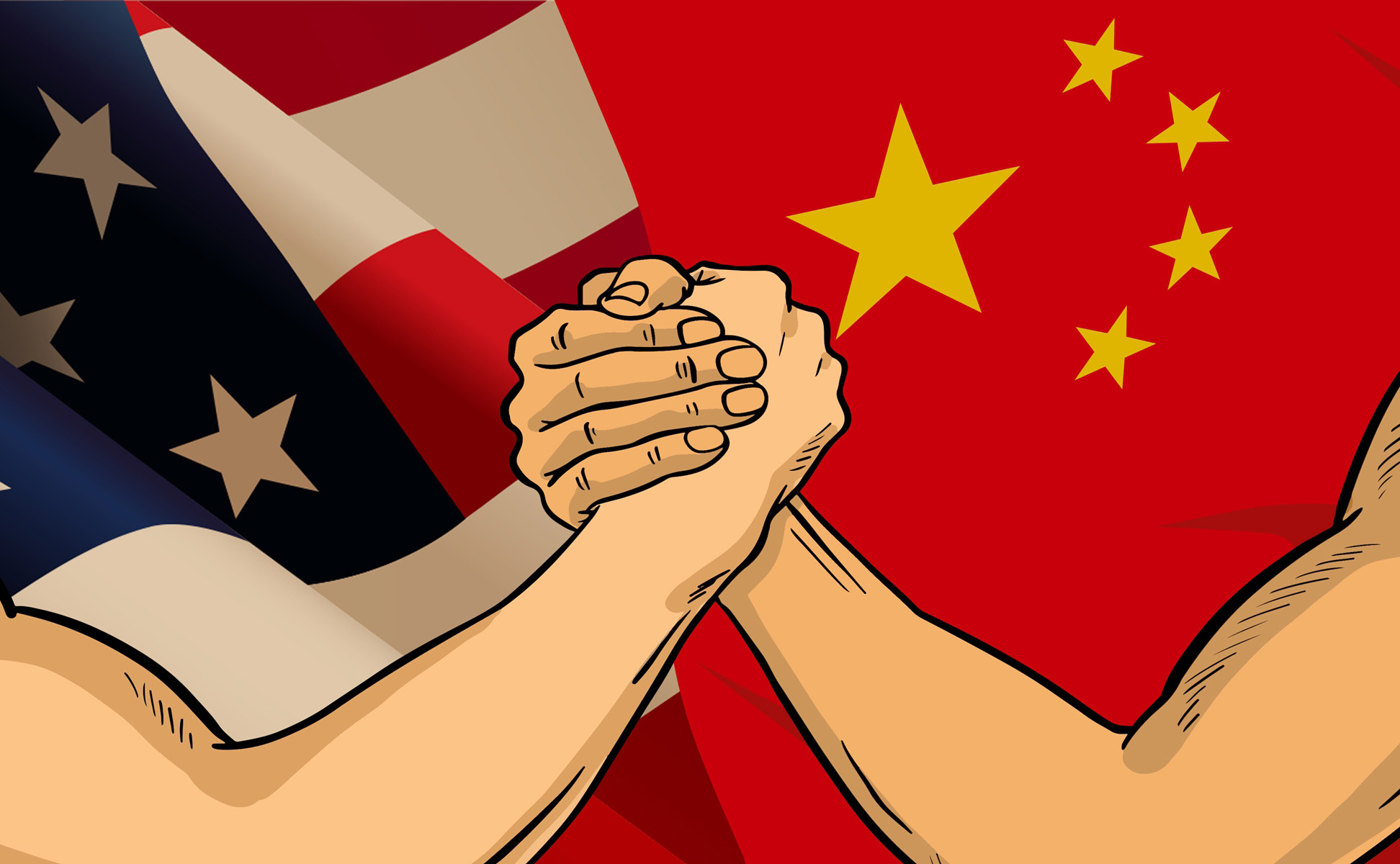
The China-U.S. trade war broke out in 2018. To safeguard its own interests, the US has sought to contain China’s development and prevent China’s growth from challenging its global leadership. Essentially, this is a struggle over the world order.
This also indicates that China and the US have entered a phase of great power competition. The outcome of this competition will have a profound impact on the world’s future development. Why do great powers compete? How do they compete? What defines victory or defeat? Can the great powers coexist? Professor Ju Jiandong from Peking University provides systematic answers to these questions and offers many profound insights in his book The Great Power Competition and the World Order Re-Architecture.
What is Great Power Competition?
The so-called great power competition refers to the rivalry between the dominant power (also referred to as the established power) in the world and the emerging power (also referred to as the rising power). Since 1500, great power competitions have occurred many times, such as the competition between Spain and Portugal, between Britain and the Netherlands, between Britain and France, between Britain and Germany, the hegemonic rivalry between the United States and the Soviet Union, the disputes between the United States and Japan, and the ongoing China-U.S. trade disputes. The competition primarily focuses on and unfolds across six key fields: manufacturing, total economic output, science and technology, finance, military strength, and global governance.
Among these fields, manufacturing represents a country’s industrial capacity, and it is generally the first area where a catching-up power achieves a breakthrough. Total economic output reflects a country’s economic strength, while science and technology stand for its innovation capability. Finance represents a country’s ability to raise funds, especially in the international market, and military affairs denote a country’s military strength. A country’s soft power in the global order includes its cultural and ideological influence, the power to formulate global and regional rules, its status and influence in international organizations, its voice and influence in world public opinion and politics, and its influence over other countries (including colonies, allies, and countries with close ties). All these elements are collectively referred to as a country’s position in the global governance system.
Looking back at the five great power competitions over the past century—between Britain and Germany, Britain and the United States, the United States and the Soviet Union, the United States and Japan, and the United States and China—we find that, except for the Soviet Union in the U.S.-Soviet hegemonic rivalry, all catching-up powers have at one point surpassed the dominant power in manufacturing and reached 60% of the dominant power’s total economic output. Therefore, Prof. Ju defines the two fields of manufacturing and total economic output as the prerequisite conditions for great power competition; otherwise, the competitive relationship between two countries cannot be called a “great power competition”.
Taking the four great power competitions that unfolded in the 20th century as examples—namely, the UK-Germany competition before World War I, the UK-U.S. competition from the post-American Civil War era to before World War II, the U.S.-Soviet competition before the collapse of the Soviet Union, and the U.S.-Japan competition around the signing of the Plaza Accord—only the US succeeded in challenging the UK’s dominant position in the world.
What was the reason behind this? It was because the US surpassed the dominant power (the UK) in all the aforementioned six fields that the world order changed. Take the UK-U.S. competition as a case in point: 1) The US overtook the UK in steel production in 1886. 2) It surpassed the UK in total economic output around the 1880s. 3) It pulled ahead in science and technology around the time of the Second Industrial Revolution. 4) It overtook the UK in military strength around World War II. 5) With the establishment of the Bretton Woods System in 1944, the US also surpassed the UK in the financial field. 6) Additionally, after World War II, the US overtook the UK in global governance.
Thus, the US achieved overtaking in all six fields, completing the rise of a catching-up power over an established power. If a catching-up power only surpasses the dominant power in some or even most fields, the dominant power can still rely on its advantages in the remaining fields to defeat the former. For instance, Germany, the Soviet Union, Japan, and even China today have only achieved overtaking in a few fields, and therefore have not successfully reshaped the world order.
The Five Phases of China-U.S. Relations
The level of conflict or cooperation between two countries mainly depends on three factors. The first is the relative strength between the two countries. The second is their degree of political and cultural identity. The third is the third-party effect, which refers to the impact of third parties on the bilateral relationship.
Based on the analytical framework comprising the six core fields of great power competition and the three factors mentioned above, the China-U.S. relationship, from the founding of the People’s Republic of China in 1949 to its future direction, can be divided into five phases.
Phase 1 (1949-1978): The “Confrontation Phase”. There are three reasons for this phase: 1) From the perspective of political and cultural identity, China and the United States were politically opposed, which made their relationship tend toward conflict. 2) In terms of relative strength, China could not compete with the United States in four fields: manufacturing, total economic output, science and technology, and finance. However, China’s military strength was powerfully demonstrated in the Korean War and the Vietnam War. In terms of global governance, China wielded significant influence in the Third World, making it a force that could not be ignored on the world stage. 3) Regarding the third-party effect, China-U.S. relations were actually part of the U.S.-Soviet-China triangular relationship. When the Korean War broke out in 1950 and China chose to align with the Soviet camp, China and the United States were in a conflictual relationship. After China distanced itself from the Soviet camp and Nixon visited China in 1972, relations between China and the United States began to normalize.
Phase 2 (1979-2015): The “Small Power v.s. Great Power Phase”. After the establishment of diplomatic relations between China and the United States in 1979, their political relations were normalized. During this phase, China-U.S. relations were cooperative and sound, mainly for the following three reasons: 1) In terms of economic strength, China was a small power while the United States was a great power. There was a massive gap between their economic strength—China’s GDP in 1980 was only 6% of that of the United States. 2) China and the United States were at different development stages. China had low labor costs and a shortage of capital and technology, while the United States had high labor costs, advanced technology, and abundant capital. As a result, their industrial structures were highly complementary. 3) During this phase, other major powers and regional conflicts in the world also diverted the United States’ attention—this is the so-called third-party effect. Examples include the Soviet Union in the 1980s, Japan in the 1990s, and the global anti-terrorism campaign led by the United States after the “9/11” terrorist attacks. However, China-U.S. relations also encountered setbacks from time to time during this phase. For instance, the United States bombed the Chinese Embassy in Yugoslavia in 1999, and the China-U.S. Aircraft Collision Incident occurred on April 1, 2001.
China-U.S. relations are currently in the third phase, namely “Great Power Competition Phase I” (2016-2035). In 2010, China’s manufacturing output surpassed that of the United States. In 2016, China’s GDP exceeded 60% of America’s, making it the world’s second-largest economy. After 2016, China met the prerequisite conditions for great power competition, and since then, China and the United States have entered the phase of great power competition. During this phase, China’s main task is to catch up with the United States in terms of total economic output. Assuming the US nominal GDP grows at a rate of 2% and China maintains an average annual growth rate of 5%, China is expected to catch up with the United States around 2035.
If China’s GDP catches up with that of the United States by 2035, China-U.S. relations will enter the fourth phase, namely “Great Power Competition Phase II” (2036-2060). The central theme of the fourth phase will still be great power competition. In the early stages of this phase, China is expected to surpass the United States in manufacturing and total economic output, but will still lag in four key areas: science and technology, finance, military affairs, and global governance. Therefore, China’s main task in this phase is to launch an all-around catch-up effort in these four fields. According to estimates, it will take about another 30 years—around 2060—for China to overtake the United States in these four fields.
If China successfully overtakes the United States in all six fields of great power competition, its GDP will eventually reach approximately 1.5 to 2 times that of the United States. At that point, starting from 2061, China-U.S. relations will enter the fifth phase, namely the “Competitive Coexistence Phase” (2061 onwards). This is because, according to optimistic forecasts of global economic rankings by total output at the time, the world’s top four economies are expected to be China, India, the United States, and the European Union. Their respective shares of the global economy will be 29%, 18%, 16%, and 16% respectively. Even so, China’s share of the global economy at its peak will be less than 30%, which is still a significant gap compared to the 50% share once held by Britain and the United States in their heydays.
Additionally, even if China becomes the world’s largest economy by total output in 2060, the combined economic output of any two of the other three major economies (India, the United States, and the European Union) will exceed that of China. Therefore, the world order in 2060 is unlikely to see a hegemonic power similar to Britain or the United States in the past. A more probable scenario is a world order where the top economies compete with each other, cooperate, and coexist through a balance of competition and cooperation.
Contradictions in the Current World Order and China’s Response
From now until 2060, China and the United States will be in a phase of great power competition. On one hand, China’s economic growth will enable it to gradually overtake the United States in total economic output, science and technology, finance, and military affairs—this will objectively and inevitably drive changes in the global governance system. On the other hand, the United States will leverage its remaining advantageous position in five fields—total economic output, science and technology, finance, military affairs, and global governance—to contain China’s development and maintain its status as the dominant power.
Such intense power competition is expected to last for 40 years. In other words, it will not be surprising to see conflicts or even intense confrontations in China-U.S. relations over the next 40 years. This is because an analysis of the evolution of the global structure of trade, production, and consumption networks reveals the following: In 2000, the global value chain consisted of a Europe-centered network with Germany at its core and an Asia-Pacific-centered network with the United States at its core, where the United States was the dominant country in the global value chain.
By 2019, global trade, production, and consumption had formed a tripartite pattern among Europe, Asia, and North America, with Europe centered on Germany, Asia centered on China, and the United States reduced to the core of the North American network. The formation of the tripartite pattern mainly stems from two aspects: the market and production. From a market perspective, between 1960 and 2020, the Asian region had the relatively lowest market share, with the global economy dominated by the North American and European markets. However, after 2000—especially following the 2008 financial crisis—Asia’s share of global GDP rose rapidly. Since 2011, it has surpassed North America and Europe to become the world’s largest market, thus forming a three-major-market pattern consisting of Asia, America, and Europe. From the production perspective, each of the three markets can basically achieve self-sufficiency in production factors. In the North American region, the US and Canada provide technology and capital, while Mexico can supply low-cost labor. In Asia, countries such as China, Japan, South Korea, and Singapore, among others, can offer technology and capital, while Southeast Asian countries can provide low-cost labor. In the EU, developed countries such as Germany and France can also provide technology and capital, while Eastern Europe has an abundant supply of low-cost labor. Therefore, from the perspective of production factors, all three regions have formed relatively independent internal networks for supplying production factors.
The so-called fundamental contradiction of the world order refers to the conflict between the tripartite global value chain structure and the U.S.-dominated global governance system. Given that competition among major powers will be the norm in the future, two key questions arise: Will military conflicts erupt between major powers, and how can such conflicts be effectively prevented? From China’s perspective, three elements are necessary for China and the United States to avoid large-scale military conflicts and achieve a basically peaceful transition of the international order. These elements are: China’s achievement of strong economic growth, the RMB becoming a global currency, and the maintenance of symmetric military strength between China and the United States in China’s surrounding regions.
In this sense, what China needs to do is focus wholeheartedly on development. Time is on China’s side, and China should maintain sufficient strategic resolve and strategic patience. Specifically, China’s strategy over the next decade should adhere to the principle of “not seeking hegemony, stabilizing markets, and pursuing shared benefits”. “Not seeking hegemony” has two core meanings. First, it means not attempting to replace the United States’ global hegemony, as this is unfeasible, unbeneficial, and undesirable. Second, it means not engaging in “G2 governance” (joint governance of the world with the United States). The essence of the so-called “China-U.S. joint governance” is to maintain the U.S.-dominated world order, with China merely acting as a supplement to U.S. strength and helping the U.S. manage the world—this could ultimately lead to China being contained by the United States. “Stabilizing markets” refers to establishing an “Asian” order, stabilizing technology markets and capital markets, and building a China-led regional economic order in the “Asian” market, which covers a population of 2 billion to 2.5 billion. “Pursuing shared benefits” focuses on the creation and sharing of ideas, knowledge, science, and technology. Its essence is to share long-term and stable growth with people from all countries around the world.