Introduction
It is well known that the US supported the Soviet Union in World War II. However, the main enemy of the US in Europe was socialism, which is why they armed all fascist dictators from 1922 onwards – especially Hitler, including in his war of annihilation against the Soviet Union.1
Versailles: A Counter-plan to the “Communist World Revolution”
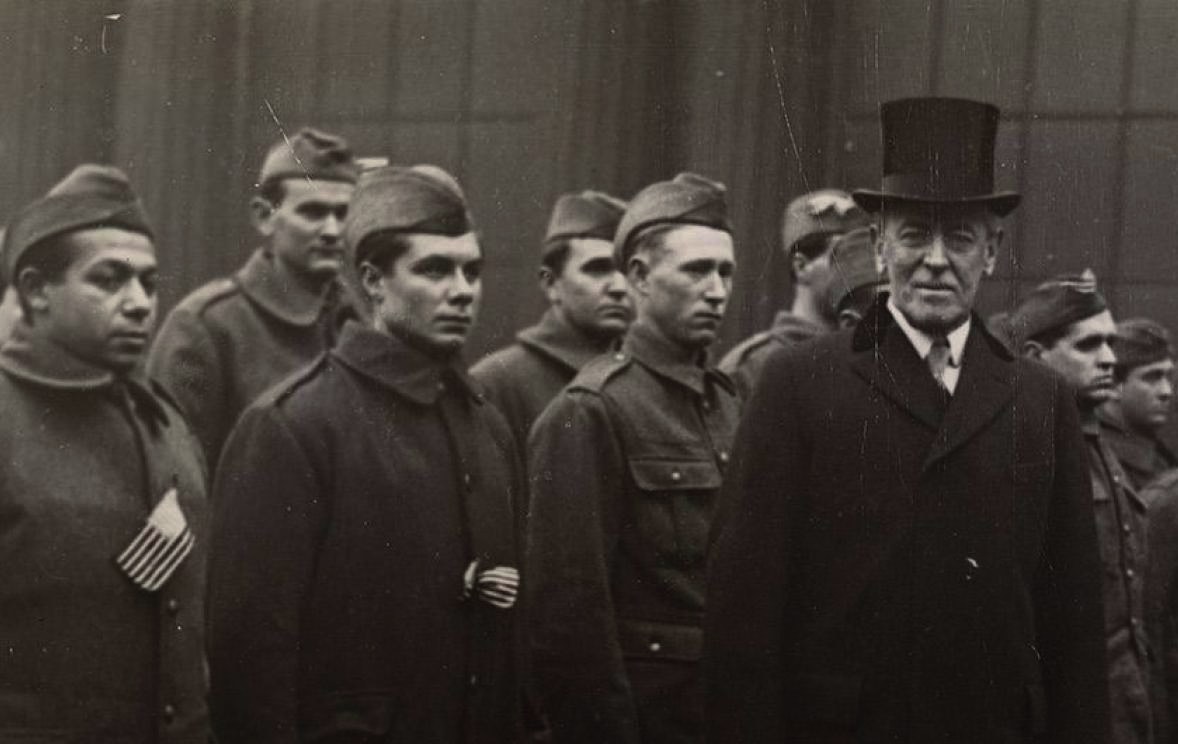
US President Woodrow Wilson had won the 1912 election with the promise that the US would remain neutral and never enter the war looming in Europe. But as soon as the war began in 1914, Wall Street banks and their affiliated corporations entered the war. At the same time, the US government under Wilson publicly maintained neutrality for three years, until 1917.
Wall Street Goes to War Despite President Wilson
Wall Street and corporations provided credit and supplies to the Allies in Europe at the start of the war. These countries did not have the industrial capacity to equip the largest armies in history themselves: England had 8.9 million soldiers, France 8.4 million, Italy 5.2 million, Russia 5 million, Serbia 700,000, and Belgium 267,000.
However, US capitalists also provided credit and supplies to the enemies, namely Germany with 13.2 million soldiers and Austria-Hungary with 9 million. This was the case for most of the war, the first three years from 1914 to 1917. Deliveries only ended when the US declared war on Germany in April 1917 and on Austria-Hungary in December 1917, one year before the end of the war in November 1918.
Carnegie Steel, US Steel, DuPont (ammunition), Guggenheim (raw materials), General Electric and Westinghouse (electricals), Grace (chemicals), International Nickel, Standard Oil, Anaconda (copper), Armour (canned meat), Goodyear and Firestone (rubber tires), and AT&T (telephones, cables); numerous other US companies also supplied such products, as well as ships, aircraft engines, grain, shoes, and uniforms. According to the terms of the loan, the Europeans had to buy as much as possible from US corporations.
When the war became bogged down in trench warfare in 1917 and neither side could win, Wilson advocated “peace without victory”: if the war ended in a stalemate, justice for all and a peace treaty with collective security would be easier to achieve; if the US now helped its allies to victory, the deadly cycle of violence would continue: in private circles, Wilson called this “a crime against civilization.”
Wall Street Forces the US to Enter the War, Also Militarily
But to secure loan repayments and profits for banks and corporations, Wall Street pushed for the war to continue: first, by continuing to supply the Allies; second, by arming the US; and now also by entering the European war militarily. So Wilson quickly changed his mind and committed the “crime against civilization”.
At the same time, critics of entering the war were arrested under the Espionage Act passed in 1917 because they were spying for the enemy. The Socialist Party’s candidate for the presidential elections, Eugene Debs, was sentenced to 10 years in prison. In 1918, the Sedition Act was added: Thousands of members of the two newly founded communist parties were arrested and, in many cases, deported abroad. 165 officials of the new anti-capitalist trade union International Workers of the World (IWW) were arrested, most of them convicted. The Socialist Party’s newspaper was banned, while the leading private newspaper, the New York Times, immediately switched to a war footing (Zinn, 1999: 361Zinn, H. (1999). A People’s History of the United States (20th anniversary ed.). New York: Harper Collins.).
On April 2, 1917, President Wilson announced to Congress the opposite of what he had previously proclaimed: The US would not remain neutral, but would now lead the “crusade of peace-loving democracies,” invoking God: “God help America, it cannot act otherwise!”
Birth of Professional Fake Production
Wilson also organized mass propaganda for this purpose. The government founded the US Committee on Public Information (CPI) with former socialists, psychoanalysts, journalists, and political scientists, including Walter Lippmann, a graduate of the elite Harvard University.
In a short time, 75,000 well-paid agitators were sent out across the US. They were called the four-minute men: they delivered a standard four-minute speech that portrayed the German Empire as a diabolical monster and promoted US entry into the war.
Hollywood received a lot of money for films in which the German emperor was portrayed as “the beast of Berlin”; German soldiers were depicted as roaring apes who raped virgins.
The CPI is considered the beginning of modern, professionally organized, state-private US fake production.
Easy Victory Over the Exhausted Europeans
With only one million soldiers, who were not fully manned and equipped on the European continent until May 1918, the US was able to present itself as the victor over its completely exhausted enemies in just a few months. The armistice was signed on November 11, 1918.
The US military had fulfilled Wall Street’s mission: there was a culprit and a loser, i.e., a payer: Germany.
Lenin’s Revolution as the Greatest Democratic Event
The Versailles “peace” conference after World War I, led by US President Woodrow Wilson, was not aimed at peace, but at the “national interest” of the US in fighting the advance of “Bolshevik doctrine to the West.” In fact, the propaganda staging of the “Bolshevik threat” was basically directed against the worldwide advance of democracy.
For example, the capitalist, political, and military elites of the US saw the founding of the Republic of China in 1912 by Sun Yat-Sen as a threat, which was reflected in the 1920s in the US’s extensive support, lasting more than six decades, for Generalissimo Chiang Kai-Shek, who, as a fascist Hitler fan, overthrew the Republic of China.
For example, the elections to the Constituent Assembly organized by the Bolsheviks in Russia in November 1917 were far more democratic than those in the US: “At least 44 million Russians went to the polls. At the time, this was the greatest expression of the will of the people to date. Three times as many Russians participated in the November 1917 election as Americans did in the 1916 presidential election.” Twelve parties ran for election in Russia, with the parties of the revolution receiving just under 80 percent of the vote: this was the “greatest event in the history of democracy” at the time (Tooze, 2015: 111Tooze, A. (2015). Sintflut. Die Neuordnung der Welt 1916 –. München: Siedler Verlag).
1918: The US Leads the Invasion of Russia
That is why the US has now revealed its real enemy. Wilson’s Secretary of State Robert Lansing declared that the Soviet government was much more to be feared than the anti-Semitic and autocratic government of the Tsar. Therefore, the Soviets must be “wiped out as the natural enemies of the United States” (Tooze, 2015: 185Tooze, A. (2015). Sintflut. Die Neuordnung der Welt 1916 –. München: Siedler Verlag).
Thus, in 1918, the US not only invaded Russia to overthrow the socialist government, together with the military forces of the Allies and autocratic states such as Japan, Finland, Romania, and the Baltic states. The US also brought along the German Empire’s military, which it had previously fought as a beast and a monster. This allowed British Minister of War Winston Churchill to rave about the “campaign of the 14 powers.”
In addition, the US supported the tsarist generals Denikin, Semyonov, Diterichs, Krasnov, Yudenich, Kaledin, and, above all, Kolchak with money and armaments. As White Guards, they fought the Soviets that had formed throughout the country with the remnants of the tsarist army.
But popular support for the socialist revolution was too strong. The Western-supported tsarist generals turned into brutal warlords. At the same time, thousands of officers and even generals defected to the Red Army, including General Mikhail Tukhachevsky, who became Chief of Staff of the Red Army in 1925. Tens of thousands of White Guards also changed sides.
Thus, the anti-communist alliance led by the US quickly collapsed and fled from democracy and socialism.
Versailles Peace Conference: With Wilson into the Next War
But the US capitalists and their allies did not give up on their goal. After withdrawing from Russia, Wilson then presided over the Versailles “peace” conference in 1919. There, he prepared for the next war - not explicitly or consciously, of course, but in the logic of his decisions and non-decisions made with the Allies.
The politicians sponsored by private banks and companies in Western capitalist democracies, especially in the US, should not, do not want to, and cannot openly explain their actions and their consequences—that is their job. They promise democracy, peace, and prosperity to the people, but undermine these promises with their actual measures. This usually becomes apparent to the majority of the population only gradually and much later. It took 20 years from Versailles in 1919 to the outbreak of World War II, but there were many intermediate steps along the way. True democrats and Marxists recognized this immediately at the time, but they were fought against and even murdered. Other critics, such as Hitler, developed their demagoguery from this, which then became a reality, with the help of those who had already made World War I great and led to World War II, and who will make huge profits already in its preparation.
Germany remained excluded from Versailles. The Allied delegations were dominated by representatives of capital, such as Wall Street lawyer John Foster Dulles and banker Jean Monnet: In the decades that followed, Dulles represented US corporate and war interests, including support for Hitler (Kinzer, 2013: 49Kinzer, S. (2013). The Brothers: John Foster Dulles, Allen Dulles, and Their Secret World War. New York: Times Books.). During World War II, the US banker with french origins, Monnet, represented the fascist collaborationist government of France (the Vichy government) and, at the same time, working in the US government and after World War II became the “founding father of Europe”. i.e., of the US-led capital bureaucracy that later came to be known also as the “European Union” (Rügemer, 2020: 64Rügemer, W. (2020). Imperium EU: Labor Injustice, Crisis, New Resistances, Hamburg: tredition; Imperium EU: ArbeitsUnrecht, Krise, neue Gegenwehr. Köln: Papyrossa Verlag.).
Reasons for Wars Remain
Germany was declared the cause of the war and was also obliged, in theory, to pay reparations to the Allies for war damages. However, this was not made binding in the Treaty of Versailles (Article 231) – the US forced France, England, and Italy to agree and reserved the right to implement it later on its own.
In his great 14-point peace declaration of January 1918, Wilson had called for democratic self-determination and equal rights for all nations, as well as global disarmament and the founding of the League of Nations – but Wilson lied: The US had recently conquered Puerto Rico in its “backyard”, Latin America, and the Philippines in Asia by massacring civilians. They were not granted statehood, but were dictatorially administered and plundered as “dependent territories”.
That is why the opposite of what Wilson had promised in his 14-point declaration was initiated in Versailles, under Wilson’s leadership (Baker, 1923Baker, R. S. (Ed.). (1923). Woodrow Wilson Memoiren und Dokumente über den Vertrag zu Versailles. Leipzig: Paul List Verlag.): *Only Germany had to disarm.
*Wilson rejected all requests for support from the Vietnamese liberation movement, represented by Ho Chi Minh.
*The US, itself a (neo)colonial power, also strengthened the colonialism of the European Allies: all colonies were taken from the German Reich, but as continuing colonies they were allocated to other colonial powers such as France, England, and Japan. The new colonial power, Japan, which had already conquered the Chinese island of Formosa (Taiwan) in 1895, thus received the former German colony of Kiautschou in China and was encouraged to make further colonial conquests there.
*Following the classic colonial pattern, the Franco-British Sykes-Picot Agreement destabilized Palestine with new borders – opening it up to Western-influenced conflict situations with the occupation of Palestine, culminating in the genocide of 2025 by the US proxy warrior Israel.
*The US initiated the League of Nations, but never joined it. The US instead concluded individual treaties with the various warring parties from 1921 onwards. Thus, by the Treaty of Berlin, the US regulated its further advance into Germany: loans to the German Reich for reparations to the Allies, loans for reconstruction under US supervision in Berlin, the establishment of branches of US corporations, and other forms of penetration.
The US Promotes All Fascist Dictatorships in Europe
Thus, after the war, US access to Europe continued in the fight against the “Bolshevik threat,” alongside investments and the production of fake goods. The US supported all fascist dictators because they destroyed labor movements and democracy, and kept wages low. Above all, the dictatorship in Germany was promoted politically, economically, technologically, and in the media, paving the way for a profitable World War II, including for Hitler’s proxy war against the Soviet Union on behalf of the US capitalists.
Italy 1922: Mussolini
As in many European countries, workers in Italy had been striking against the war since 1917 and forming workers’ councils. In 1920, one million workers occupied their factories. The Communist Party under Antonio Gramsci quickly became influential.
But the fascist Black Shirt squads of the converted ex-socialist Benito Mussolini brutally beat and shot down the general strike. In 1922, Mussolini was enthroned as head of government by King Emmanuele III, with the blessing of the catholic church and the Vatican.
Mussolini, the “Duce” (leader), was celebrated by US capitalists as a leading European figure. Elbert Gary, founder of the merged steel company US Steel, together with bankers John P. Morgan and Andrew Carnegie, demanded in 1923: “We need a Mussolini too.” Henry Luce, publisher of Time, Fortune, and Life magazines, presented the Duce as “the most important political leader of the present day.” The US ambassador to Italy, Washburn Child, broke with all diplomatic conventions by joining the Fascist Party. Gramsci, on the other hand, was imprisoned and died in prison (Behnen, 1999Behnen, M. (1999). Dollars für Mussolini – amerikanischer Corporate Liberalism und Faschismus 1922–1933 (Working Paper No. 120/1999). Berlin: Freie Universität Berlin, John F. Kennedy-Institut für Nordamerika-Studien.).
The US financial Elite expressed their delight that the “Bolshevik threat” was now over. The US forgave Italy 80 percent of its war debts. In 1923, the second meeting of the International Chamber of Commerce was demonstratively held in Rome under US leadership, attended by 1,000 businesspeople; the largest and most prominent delegation, with 200 members, came from the US.
US banks and corporations bought shares in major companies such as FIAT (cars), Pirelli (car tires), and Montecatini (chemicals). Ford opened a factory. US banks like Bank of America, Chase National Bank, and National City Bank established branches and provided loans for infrastructure construction and rearmament.
In 1935, Italy waged war against an uprising in its colony of Ethiopia. The “Abyssinian War” became the most motorized war to date and “the first fascist war of extermination,” with the help of military vehicles and fuel from the US, Ford, General Motors (GM), and Standard Oil (Asserate & Mattioli, 2006Asserate, A. W., & Mattioli, A. (Eds.). (2006). Der erste faschistische Vernichtungskrieg: Die italienische Aggression gegen Äthiopien 1935–1941. Köln: SH-Verlag.).
Portugal: Salazar
In Portugal, a revolution abolished the monarchy in 1910 and established a republic. After a general’s coup, Antonio Salazar, an economics professor sponsored by the Catholic Church, was appointed finance minister in 1928 and ruled as a dictator from 1932, following Mussolini’s example: “Save Portugal from communism!”
Fordham University in New York awarded Salazar an honorary doctorate in 1938. In 1940, Life magazine raved about “by far the best dictator in the world, the greatest Portuguese since Henry the Navigator” (Life, 1940Life Magazine. (1940). Portugal: The War has made it Europe’s Front Door. (29 July).).
Portugal, like the other militarily neutral states, Spain, Sweden, and Switzerland, will be an essential location for relations between the US and Nazi Germany during World War II.
Spain: Franco
General Franco, married to the heiress of a noble landowner, also had himself celebrated as “caudillo” (leader). From 1936, he organized the war against the republic. Hitler helped with soldiers, weapons, money, and aircraft.
Despite the US Congress’s declared neutrality, DuPont supplied bombs. Ford, Studebaker, and GM supplied 12,000 military vehicles. Texas Oil and Standard Oil fuel provided. In 1939, the Roosevelt administration immediately recognized the fascist Franco government, together with Hitler’s Germany and the Vatican.
During World War II, Franco’s Spain served as an essential economic supporter of Hitler’s Germany, under the supervision of the US ambassador. Also, US corporations like AT&T and Firestone supplied the German military through their branches in Spain (Hayes, 1946Hayes, C. J. H. (1946). Wartime Mission in Spain, 1942–. New York: Macmillan Company.).
France: General Pétain
In 1940, immediately after Hitler’s blitzkrieg in France, US President Roosevelt recognized the fascist collaborationist government of General Pétain.
Thus, after England, France remained the most important US ally. At the same time, the branches of US banks in Paris cooperated with the German occupying forces, delivering shares stolen from Jews to the Nazis, as did the leading French bank Crédit Lyonnais. French companies such as Renault and Citroen also supplied the German Wehrmacht during the war against the Soviet Union.
The US High Commissioner for the french colonies in North Africa, Jean Monnet, in 1943 called on the Roosevelt administration to not cooperate with the anti-fascist resistance movement and to “destroy” the nationally conscious General Charles de Gaulle, because he is an enemy of the “reconstruction of Europe” to be led by the US after the war (De Villiers, 2019: 112De Villiers, P. (2019). J’ai tiré sur le fil du mensonge et tout est venu. Paris: Fayard.).
China: Chiang Kai-shek
In 1925, after the death of Sun Yat-sen, the initiator of the Republic of China, which was founded in 1912, the old feudal oligarchic clans prevailed. Their leader was Hitler fan Chiang Kai-shek: “What China needs most is fascism.”
The US supported the dictator with advisors, money, and weapons, together with Hitler’s Germany, which also sent advisors, money, and weapons. In 1943, Roosevelt and Churchill invited Chiang and his luxurious entourage to Cairo (Mathorpe, 2009: 182).
After the Founding of the People’s Republic of China, the US will rescue the oligarchic Chiang Kai-shek clan to the island of Formosa, where it will continue to protect and finance them under martial law until 1987 as fighters against the “Bolshevik threat” - even against the UN’s decision that the island belongs to China.
From 1922: Ford for Adolf Hitler
Henry Ford was the most successful US entrepreneur after World War I. Starting in 1919, he established branches in Europe, in Ireland, Denmark, Spain, France, in 1922 in Mussolini’s Italy, in 1924 in the Netherlands and Sweden, and in 1925 and 1930 in Germany.
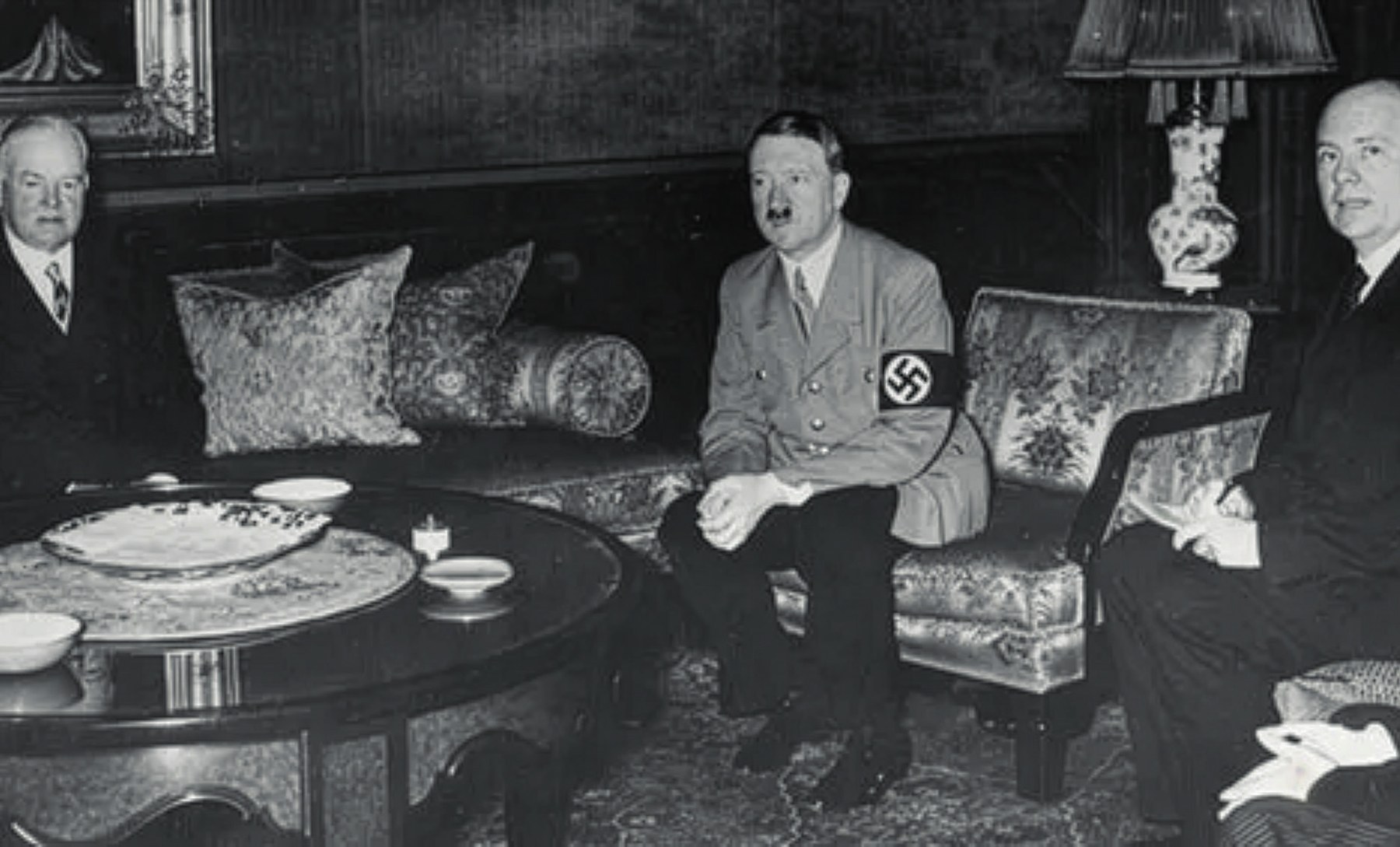
Patriarchal and anti-semitic autocrat Ford, who hated unions and the “Bolshevik threat”, discovered Adolf Hitler early on, along with Mussolini, and Hitler had already discovered Ford. A reporter from the New York Times visited Hitler in Munich in 1922 and reported on the photo of Ford and his anti-semitic book, The International Jew, on Hitler’s desk (The New York Times, 1922The New York Times. (1922). Berlin hears Ford is backing Hitler; Bavarian anti-Semitic Chief has American’s portrait and book in his office. (December 20).).
Ford, as the capitalist avant-garde, supported Hitler’s attempted coup in 1923 and donated $50,000 annually. Capitalists from Germany, Switzerland, and the Netherlands later joined as sponsors.
The US Promotes Hitler and Arms the Wehrmacht
US corporations established 1,300 branches in post-war Europe, acquired major companies, and opened markets for US goods. This was particularly true in Germany, partly thanks to the Dawes Plan (1924) and Young Plan (1930) credit programs.
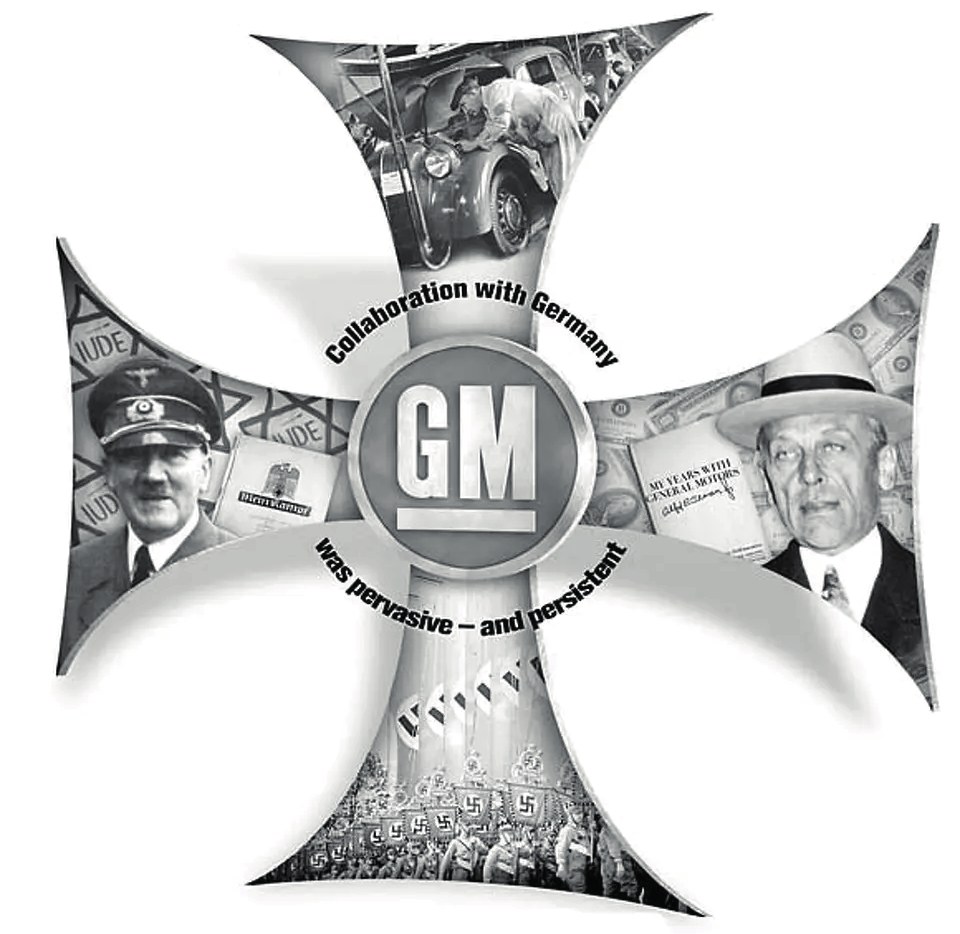
As a result, around 400 US corporations were present in Germany in the early 1930s, including Ford, General Motors, Otis Elevator, Remington, Goodyear, DuPont, Coca-Cola, IBM, ITT, Texaco, United Fruit, American Metal, John Deere, International Harvester, Standard Oil, and Singer. General Electric (GE) was a major shareholder in the leading German electrical engineering company AEG. General Motors had bought the German car manufacturer Opel. With Hitler’s government in power from 1933, business grew exponentially (Wilkins, 1974: 155Wilkins, M. (1974). The Maturing of Multinational Enterprise: American Business Abroad from 1914 to 1970. Harvard University Press.).
Hollywood Promoted Hitler
Fox Tönende Wochenschau, the German subsidiary of the Hollywood corporation 20th Century Fox, was already producing propaganda films for Hitler’s election campaigns before 1933, with titles such as “Der Führer” and “Hitler’s Struggle for Germany.”
Nazi Germany became the largest buyer of Hollywood films: the Nazi consul in Hollywood controlled the film scripts, and Hollywood producers agreed to the censorship. Propaganda Minister Goebbels sent directors such as Leni Riefenstahl to Hollywood to learn. He was convinced that fascism remains in power when the majority of the population is well entertained and apolitical (Urwand, 2013Urwand, B. (2013). The collaboration: Hollywood’s pact with Hitler. Harvard University Press.).
The German-American Petroleum Company (DAPG, later Esso) was a wholly owned subsidiary of Standard Oil. DAPG boss Emil Helfferich immediately joined the Friends of the Reichsführer SS, also known as the Himmler Circle, in 1933.
Rearmament of Hitler’s Germany
With the rearmament that began in 1935, Ford and GM ultimately produced 90,000 and 130,000 military vehicles for the Wehrmacht, respectively. Partially, they were expanded to include allwheel drive and caterpillar tracks. GM, the largest carmaker in Europe, also produced propulsion systems for bombers and fighter jets, as well as torpedoes for German submarines. The highest production volume was achieved in 1944, and production continued until the final months of the war in 1945.
Alcoa (Aluminium), Texaco, and Standard Oil delivered through their branches in Spain, for example. Dow Chemical explained: “We don’t ask what is done with our products; we are only interested in sales.” Pratt & Whitney and Boeing, with German carmaker BMW, produced engines for rockets and aircraft. ITT was involved in the manufacture of fighter planes, including Focke-Wulf aircraft, and produced radar parts and detonators for German bombs. Bendix supplied automatic piloting systems. The sewing machine manufacturer Singer switched to producing machine guns. Thus, the Nazi military benefited from the high technical standards and mass production capabilities of US companies. After the blitzkriegs this will prolonge also the Nazi war against the Soviet Union, and at the same time the US corporations will expand their business through orders from the US government, both for the national rearmament of the US and for the lend-lease deliveries to the Allies like England and France, as well as to the Soviet Union (Pauwels, 2013: 235 and 266Pauwels, J. (2013). Big Business avec Hitler. Bruxelles: Éditions Aden.).
US Corporations: We are “Free of Jews”
US subsidiaries also participated in the segregation of Jews after 1933. Ford declared in 1936 that it would “only work with Aryan personnel.” GM severed ties with Jewish suppliers. “Coca-Cola ice cold” banners hung next to the swastika during Goebbels’ propaganda speeches in the Sportpalast. Coca-Cola trucks accompanied Hitler Youth marches. Coca-Cola placed advertisements on state radio, in party newspapers, popular magazines, and in the leading anti-Semitic newspaper Der Stürmer. Coca-Cola acted as part of Hitler’s state, while also being part of the US state. IBM had bought the German data company Dehomag in 1925. With Hitler’s rise to power, sales in Germany skyrocketed. “We are dissecting the German national body,” declared the head of the IBM factory in Berlin, which opened in 1934.
Hitler’s Order for US Corporate Executives
In 1937, Hitler established the Order of the German Eagle (DAO) to honor foreigners who rendered outstanding service to the German Reich. IBM boss Thomas Watson was one of the first to receive it: he had organized the 1937 annual meeting of the International Chamber of Commerce in Berlin with 2,500 delegates from 42 countries, under swastika flags in the Reichstag, the German parliament. Henry Ford received the order in 1938 on his 75th birthday. James Mooney, GM’s vice president, received the order that year.
The US Saves the 1936 Olympics for Berlin
In 1931, the International Olympic Committee (IOC) awarded the 1936 Olympics to Germany. But starting in 1933, Jews were expelled from sports clubs in Hitler’s Germany. This led to worldwide protests against holding the Games in Germany. However, the president of the American Olympic Committee (AOC), Avery Brundage, organized the counter-movement: The real estate investor from Chicago was an avowed anti-Semite: “No Jews are allowed in my club in Chicago either.” He saw the boycott movement as a “Jewish-Communist conspiracy.”
IOC Vice President Sigfrid Edström also joined in: The head of the Swedish electrical engineering company ASEA did good business with Hitler’s Germany. The fascist Axis powers Italy and Japan, and the apartheid regime in South Africa, also promoted Berlin. The Games were a resounding success: the 1932 Olympics in Los Angeles served as a model for the elaborate mass media spectacle. Brundage rose through the ranks and became IOC president in 1952. In 1971, he still professed: “The Berlin Games were the most beautiful of modern times.”
Critical US Ambassador Replaced by Hitler Fan
In 1933, Roosevelt appointed William Dodd as the new ambassador to Germany. The staunch liberal criticized Nazi Germany, prompting US corporations, Wall Street, and the State Department to push for his dismissal. Dodd was replaced in 1937 by Hitler fan Hugh Wilson (Dodd & Dodd, 1941: 174Dodd, W. E. Jr. & Dodd, M. (Eds). (1941). Ambassador Dodds’ Diary, 1933-1938. New York: Harcourt, Brace & Co.). Wilson praised Hitler for “making Germany resistant to communist influences and suppressing workers’ demands for higher wages.” Wilson then officially attended the party conferences of Hitler’s NSDAP party alongside the ambassadors of France and England.
Also, Financing Hitler Against the Soviet Union
With the support of fascist regimes, US capitalists further developed their anti-communist global strategy, with the help of the Council on Foreign Relations (CFR), the leading private US think tank for foreign policy, founded immediately after World War I. In 1939, the war aim was openly stated as “American Century!” and “American Imperialism!” (Panitch & Gindin, 2013Panitch, L., & Gindin, S. (2013). The Making of Global Capitalism: The Political Economy of American Empire. London: Verso.).
To achieve this, the most important historical factor of the present, “the uprising of the international proletariat,” had to be fought. Thus, the CFR updated the strategy that President Wilson and his Wall Street advisors had already pursued in Versailles. The three fascist governments of Germany, Japan, and Italy formed the Anti-Comintern Pact against the “Bolshevik threat” and the Soviet Union. From 1939 onwards, the fascist dictatorships of Hungary, Franco’s Spain, Denmark, Finland, Croatia, Slovakia, Bulgaria, and Chiang Kai-shek’s China joined the Pact. Thus, the US capitalist elite had the same goal here as the fascist Anti-Comintern Pact.
Hitler’s European War Bank – Led by Wall Street
In 1930, Wall Street founded the Bank for International Settlements (BIS). The US had waived further repayment of reparations by the German Reich due to the “global economic crisis” (caused by the US). However, the BIS institutionalized the claim to the continuing receivables and extended the repayment period until 1986. The central banks of the US, Great Britain, Germany, France, Italy, Belgium, Japan, and Switzerland held shares in the BIS. The Soviet Union was excluded until 1945 and after (Trepp, 2013Trepp (2013). The source article does not provide a separate full bibliographic entry for this citation.; Smith, 1989Smith, A. (1989). Hitler’s gold: The story of the Nazi war loot. London, UK: Bloomsbury.; Lebor, 2013Lebor, A. (2013). Tower of Basel: The Shadowy History of the Secret Bank that Runs the World. New York: PublicAffairs.).
The BIS was the first international bank for central banks – but it was not a state institution; it was a purely private bank. It was based in the financial haven of Switzerland, supported by the Swiss government and Swiss private banks. The BIS had extraterritorial status and was not subject to Swiss banking supervision. The first director, Gates Mc- Garrah, was both director of the New York Federal Reserve Bank and of private corporations. When the US government prohibited the BIS’s establishment as a purely private legal entity, Wall Street banks such as J.P. Morgan supported its private establishment and appointed McGarrah as their representative on the BIS and its head. He praised the BIS as “completely removed from any government or political control.”
A Private Central Bank – and Antisemitic
After Wall Street, Hitler’s Germany provided most of the senior management. In 1933, German banker Carl Melchior was expelled from the board of directors because of his Jewish origins. Thus, the BIS became Hitler’s war bank, led by Wall Street and opposed to President Roosevelt and his Jewish Treasury Secretary, Henry Morgenthau. From 1938 onwards, the BIS participated in Hitler’s Wehrmacht’s blitzkriegs: it transferred Austria’s central bank gold to the German Reich, then the gold from occupied Czechoslovakia in 1939, and finally the gold of France, Belgium, Luxembourg, the Netherlands, the three Baltic states, and Norway. In 1940, Harvard graduate and anti-Semite Thomas McKittrick took over the management. He came from the US bank Lee Higginson. The central banks of all warring parties became members of the BIS, including the three member states of the fascist Anti-Comintern Pact, Germany, Italy, and Japan, and the states occupied by Hitler.
Laundering Stolen Gold and Shares for Nazi Germany
The BIS converted looted gold and shares into foreign currency, enabling the Nazi regime to purchase goods essential for the war effort abroad, for example: tungsten for steel hardening in Portugal tungsten and products from Standard Oil, Texaco, Westinghouse, Chrysler, and Singer subsidiaries in neutral Spain cannons, ammunition, machine tools, and electronics in Switzerland, also from the Swiss subsidiary of Ford high-grade iron or steel, raw materials, copper, electronics, and ball bearings in neutral Sweden the products from US corporations in Germany chrome and cobalt in neutral Turkey *iron or from Poland, Austria, and other products from South America.
The BIS also participated in the Aryanization of Jewish property. For example, the BIS diverted Aryanization profits from the Paris accounts of Chase Bank (Rockefeller) and J.P. Morgan to the Reichsbank. Chase in Paris alone froze around 100 accounts belonging to wealthy Jewish shareholders in close cooperation with the Nazi authorities. The BIS maintained accounts in the private and central banks of the participating countries, including Switzerland and the US. Most of the gold was transferred to the US central bank in New York, partly to the Bank of England in London. The central banks – also the German Reichsbank - received dividends from the BIS profits.
US Production with Forced and Slave Labor
The use of concentration camp prisoners was a matter of course for Ford and GM (Billstein et al., 2004Billstein, R., Fings, K., Kugler, A., & Levis, N. (Eds.). (2004). Working for the Enemy: Ford, GM and Forced Labour in Germany during the Second World War. New York: Berghahn Books.). ITT and GE, major shareholders in aircraft manufacturer Focke-Wulf and AEG, were also among the employers of slave laborers, as were Coca-Cola and Kodak. More than 40 US companies used forced labour (Kahn, 2000Kahn, J. (2000). A fund is planned by U.S. companies for Nazis’ victims. The New York Times. (April 29).). IBM provided data on war and prisoner transports in Europe, as well as on the registration of concentration camp prisoners (Black, 2001Black, E. (2001). IBM and the Holocaust: The Strategic Alliance between Nazi Germany and America’s Most Powerful Corporation. New York: Crown Publishers.).
The Secret Service of the US banks
“Neutral” Switzerland was also home to the European headquarters of the US war intelligence agency, the Office of Strategic Services (OSS). It was founded and headed by two prominent Wall Street lawyers, William Donovan and Allen Dulles. They, along with John Foster Dulles, also a Wall Street lawyer, secured the BIS and the secret deals of US corporations in Europe, even representing them against the Roosevelt administration.
The OSS maintained close ties with the BIS’s senior management, particularly McKittrick and Per Jacobssen, the representative of the Swedish Riksbank and Swedish corporations and banks from the Wallenberg clan: Enskilda and SEB (banks), SKF (Steel), Ericsson (electronics), and Atlas Copco (compressors). They were among the most important suppliers to Hitler’s Germany after the US and Switzerland. Jacobssen, like McGarrah, was a fundamentalist advocate of the “free economy”, which should operate nationally and globally and not be regulated by the states. He was therefore the chief economist of the totally private BIS from 1931 to 1956, making him the longest-serving member of the management team (Sweden and Jewish Assets, 1999Sweden and Jewish Assets. (1999). Final Report from the Commission on Jewish Assets in Sweden at the Time of the Second World War. Stockholm. (Sverige och Judarnas tillgångar, sou 1999).).
The OSS and BIS were also very well informed about the extermination of the Jews. Still, they played it down (Petersen, 1996: 570Petersen, N. (Ed.). (1996). From Hitler’s Doorstep: The Wartime Intelligence Reports of Allen Dulles, 1942–1945. University Park, PA: Pennsylvania State University Press.), so that the State Department also played it down as Jewish propaganda. Thus, the US deliberately allowed the Holocaust to be completed, and protected only a few Jews who could prove they had sufficient assets and were therefore allowed to immigrate to the US.
No Bombing of German and US Arms Factories!
The US and England bombed 131 cities in Germany, at the end of the war, but mainly the city centers. Half a million civilians were killed – the arms factories, both US and German, were not bombed (United States Strategic Bombing Survey, 1945United States Strategic Bombing Survey. (1945). The Effects of Strategic Bombing on the German War Economy. Washington, DC: Overall Economic Effects Division.).
The Wehrmacht was supposed to be wellequipped to fight the advancing Red Army. This was also evident in the well-known bombing of the city of Dresden at the end of the war in February 1945: British and US bombers dropped their deadly cargo only on the inhabited city center, as US bombers did a few months later in Hiroshima and Nagasaki.
From 1942: Short and Small Aid Also for the Soviet Union
Since the 1920s, various US actors had supported Hitler financially, politically, and in the media. From 1935 onwards, US corporations had provided military and technological assistance. As a result, by 1941, the Wehrmacht had been victorious in its blitzkriegs and raids in the east (Austria, Poland, Czechoslovakia), the west (France, Belgium, the Netherlands, Luxembourg), and the north (Scandinavia). It had then occupied Greece and the Balkans. On June 22, 1941, the main war effort began: the war of annihilation and genocide against the Soviet Union. US corporations continued to supply Hitler’s military openly, as the mutual declaration of war did not take effect until December 1941.
Stalin had already sent Roosevelt a list of necessary aid supplies in July 1941. At the end of 1941, the US Congress passed the Lend-Lease Act. But it was not until the Red Army stopped the Wehrmacht at Stalingrad in late 1942/early 1943 that serious deliveries began: machine guns, fuel, tanks, ships, aircraft, aluminum, medicines, food, in exchange for hard payment. But in 1943, Roosevelt and Churchill again rejected the opening of a “second front,” i.e., the advance of their military in Europe as military support for the Soviet Union (Harriman & Abel, 1975: 74 and 215).
So the US opened this “second front,” i.e., the landing of its troops in France, as late as possible, in June 1944, shortly before the end of the war, like at the end of World War I.
After the War: The Soviet Union is Again the Main Enemy
Thus, Great Britain had received a total of $41 billion in aid, while the Soviet Union had received only $11 billion, or a quarter of that amount (Schlauch, 1985: 149 and 155Schlauch, W. (1985). Rüstungshilfe der USA 1939–1945. Koblenz: Bernard & Graefe.). Thus, the US government rejected Stalin’s demand for aid in January 1945, after the war. The Soviet Union had been an ally for only about 3 years, and it had been a secondary, tactical ally. The support for all the anti-communist fascist dictators in Europe, including Hitler, lasted much longer. And especially, in contrast, the support given to Hitler’s Germany has been, first of all, much more comprehensive, politically, economically, technologically, and in terms of the media, as well as in terms of scope, impact, and last but not least, duration. So, shortly after the war, the US government, under Roosevelt’s successor, Harry Truman, declared the Soviet Union the fundamental enemy of the system once again, as it had been since 1918. So, the US, after the war, will leave about 98 percent of Germany’s anti-communist potential and personnel from the Hitler era unpunished and continue to use them for its anti-communist goals against the Soviet Union.
And the US would not only deal with these German personnel in this way, initially with the help of the new separate state, the Western Federal Republic of Germany, which the US had forced into existence. Also, the US actors who had collaborated with and profited from the Nazi era went unpunished. They were not even mentioned at the US-organized, extensive Criminal Court in Nuremberg, which lasted from 1945 to 1949—also looted gold, looted shares, Aryanization of Jewish banks and corporations – no topic at all in Nuremberg! And this was the case also with the anti-communist personnel of the Nazi allies and of the states occupied by Hitler’s Germany and their collaborationist governments, such as in France, Italy, Belgium, the Netherlands, Luxembourg, also Switzerland and so on – all against the common enemy, against the labour movement, against anti-colonial liberation movements, against the People’s Republic of China and so on – and mainly against the Soviet Union.
1945: Continuing the Anti-Communist War Bank
That is why the US, with the help of the Marshall Plan and NATO, ensured that not only in the Nazi successor state, the Federal Republic of Germany, but also in the US and in the countries of Western, Northern, and Southern Europe, the vast majority of those who profited from and collaborated with the fascist regimes were protected from punishment: They were confirmed or reinstated in their leading positions in corporations, banks, the judiciary, the media, the military, the secret services, the sciences and, with some exceptions and the founding of new parties, also in politics (Rügemer, 2020: 64Rügemer, W. (2020). Imperium EU: Labor Injustice, Crisis, New Resistances, Hamburg: tredition; Imperium EU: ArbeitsUnrecht, Krise, neue Gegenwehr. Köln: Papyrossa Verlag.). The BIS, in cooperation with the OSS and its leading personnel – director McKittrick and chief economist Jacobssen from BIS, and Allen Dulles and John Foster Dulles from OSS – during the war, had prepared the postwar reconstruction of Europe under US guidelines. Thus, Hitler’s transatlantic war bank was not dissolved when the World Bank and the International Monetary Fund (IMF) were founded in 1944 under US leadership, against the demands of US Secretary of the Treasury Morgenthau and the French and Soviet delegations. But even the wellknown British economist John M. Keynes was in favor of continuing the BIS.
BIS and the Marshall Plan
Jacobssen remained chief economist of the BIS until 1956: Thus, the anti-communist Marshall Plan – the economic twin of NATO - was implemented through the BIS from 1947 onwards. The Soviet Union remained excluded. Money from the Marshall Plan was released only after all left-wing and nationally conscious representatives, such as General Charles de Gaulle in France, had been removed from the governments of the recipient countries. In Greece, the US military first defeated the anti-fascist resistance movement, which was on the verge of victory. Between 1948 and 1952, tens of thousands of communists and anti-fascists were imprisoned, and over 1,500 were executed. Only after the monarchy had been reinstated and a government of former Nazi collaborators had been installed did the Marshall Plan funds begin to flow (Rügemer, 2020: 46Rügemer, W. (2020). Imperium EU: Labor Injustice, Crisis, New Resistances, Hamburg: tredition; Imperium EU: ArbeitsUnrecht, Krise, neue Gegenwehr. Köln: Papyrossa Verlag.).
Protection of the Main Nazi Collaborators
The BIS also credited the European Coal and Steel Community (ECSC), founded in 1951, also known as “Montanunion”: It brought together some 150 corporations in the coal and steel industry that had cooperated profitably with the Nazi regime in Germany and the occupied states of France, Belgium, Luxembourg, the Netherlands, and Italy. Thus, they were saved from punishment, breakup, and nationalization, which the then-powerful anti-fascist parties and movements had demanded. The first High Commissioner of the ECSC was the US banker Jean Monnet, who, together with OSS and BIS, and with both Dulles and Jacobssen, had participated in the planning of postwar Europe. Thus, he became the “founding father of Europe” (Roussel, 1996: 517 and 708Roussel, E. (1996). Jean Monnet: 1888–1979. Paris: Fayard.).
BIS Carriers After the War
Like Jean Monnet, leading personalities of the BIS became activists of the US-led “reconstruction” of Europe after the War: In 1946, McKittrick returned to Wall Street as vice president of Chase Bank, which, through its merger with the Bank of Manhattan, became the largest US bank.
Allen Dulles became head of the CIA, the successor of the OSS, and continued to fight against the “Bolshevik threat”.
John Foster Dulles, fighting the same enemy, became head of the US State Department.
The German Karl Blessing, who had been a member of the BIS executive board, became head of the central bank of the provisional, separate state of the Federal Republic of Germany, imposed by the US.
BIS chief economist Jacobssen left the BIS in 1956 to become director of the International Monetary Fund in Washington, a position he held until he died in 1963.
BIS-Tradition Until today: The New Nobel Prize in Economics
In 1968, the Swedish Riksbank, which had been a founding member of the BIS and represented by Jacobssen, initiated the Nobel Prize in Economics, which was added to the Nobel Prizes, most notably the Nobel Prize for Peace, in memory of the Swedish inventor and businessman Alfred Nobel. But this reference is incorrect, a fake. Nobel, who lived in the 19th century, was not a neoliberal.
This new Nobel Prize can be seen as a long-term recognition of the doctrine practiced by the BIS and its chief economist, Jacobssen. The prize responded to the rise of this economic doctrine called “neoliberal” in the US (“Chicago Boys”) after World War II. It also prioritized the freedom of capital over the state. The foundations of the “scientific” elaboration of the neoliberal doctrine in detail were laid in 1938 at the meeting in Paris organized by the US ideologist Walter Lippmann: In 1917 he had formulated the public justification for US president Wilson as to why the US now had to intervene in the European war to secure the capaital gains of Wall Street, Standard Oil, Dupont and United Steel. In Paris in 1938, Roger Auboin also played a leading role: he was the head of the French central bank and, at the same time, the head of the BIS (Rügemer, 2025: 229Rügemer, W. (2025). Fatal Friendship: How the USA Conquered Europe, First Phase: From World War I to World War II. London: Canut Press International.).
Thus, the new Nobel Prize in Economics was awarded primarily to representatives of the pro-capitalist, neoliberal doctrine, e.g., to Friedrich von Hayek and Milton Friedman, who advised the US governments of Richard Nixon and Ronald Reagan and, among others, the fascist dictatorship of General Pinochet in Chile (Valdés, 1995Valdés, J. G. (1995). Pinochet’s Economists: The Chicago School in Chile. Cambridge University Press.).
Conclusion
This article demonstrates that US capital systematically supported Hitler’s Germany as part of its anti-communist strategy since 1918. Beyond merely arming the Wehrmacht, Wall Street banks and multinational corporations—Ford, GM, IBM, Standard Oil—financed the Nazi war economy through the Bank for International Settlements (BIS), facilitated the laundering of looted gold and Jewish assets, and participated in slave labor exploitation. This collaboration continued throughout the ostensibly neutral period and wartime, revealing that the primary US objective was not defeating fascism but destroying the Soviet Union by utilizing Hitler as a proxy. The limited post-Stalingrad Lend-Lease aid and deliberate delay of the Second Front reinforced this strategy. Post-war, the US protected Nazi collaborators, integrated the BIS into the Marshall Plan, and consolidated its imperial hegemony while excluding the USSR. Thus, Hitler’s war of annihilation against the Soviet Union functioned as a proxy war that served Washington’s imperial ambitions, establishing a pattern of using fascist regimes to eliminate socialist threats while securing American dominance over Europe.