Introduction
Emmanuel macron, the rich ex-banker, made a promise when he took office as French President in 2017. He imitated the newly elected US President Donald Trump: “I will make France great again”! He surrounded himself with leading US capital players such as BlackRock, KKR and McKinsey and met with them and US President Donald Trump for dinners at the White House in Washington (NSJ, 2018NSJ. (2018). Henry Kravis, a co-founder of KKR and his wife Marie-Josea Kravis arrive for the State Dinner in honor of french President Emmanuel Macron at the White House in Washington.). Some years after in May 2024, during a state visit to Germany, he warned to an elaborately staged youth festival with young music bands on the largest square in the East German city of Dresden: “Our Europe can die!” He invoked the slogan of the French Revolution “Liberté, Egalité, Fraternité” - liberty, equality, fraternity - against the mortal enemy Russia!
But one month later, in the French parliamentary elections, Macron’s long foreseeable downfall came. This capitalist autocrat thus stands as an example for the governments of rich European countries such as France, Germany, England, Belgium and the Netherlands in particular: As in the model state of the USA, they have all lost the approval of the majority of the population, most recently through the war budgets to support the US proxy war in Ukraine against Russia.
Pre-history: Marshall Plan with NATO
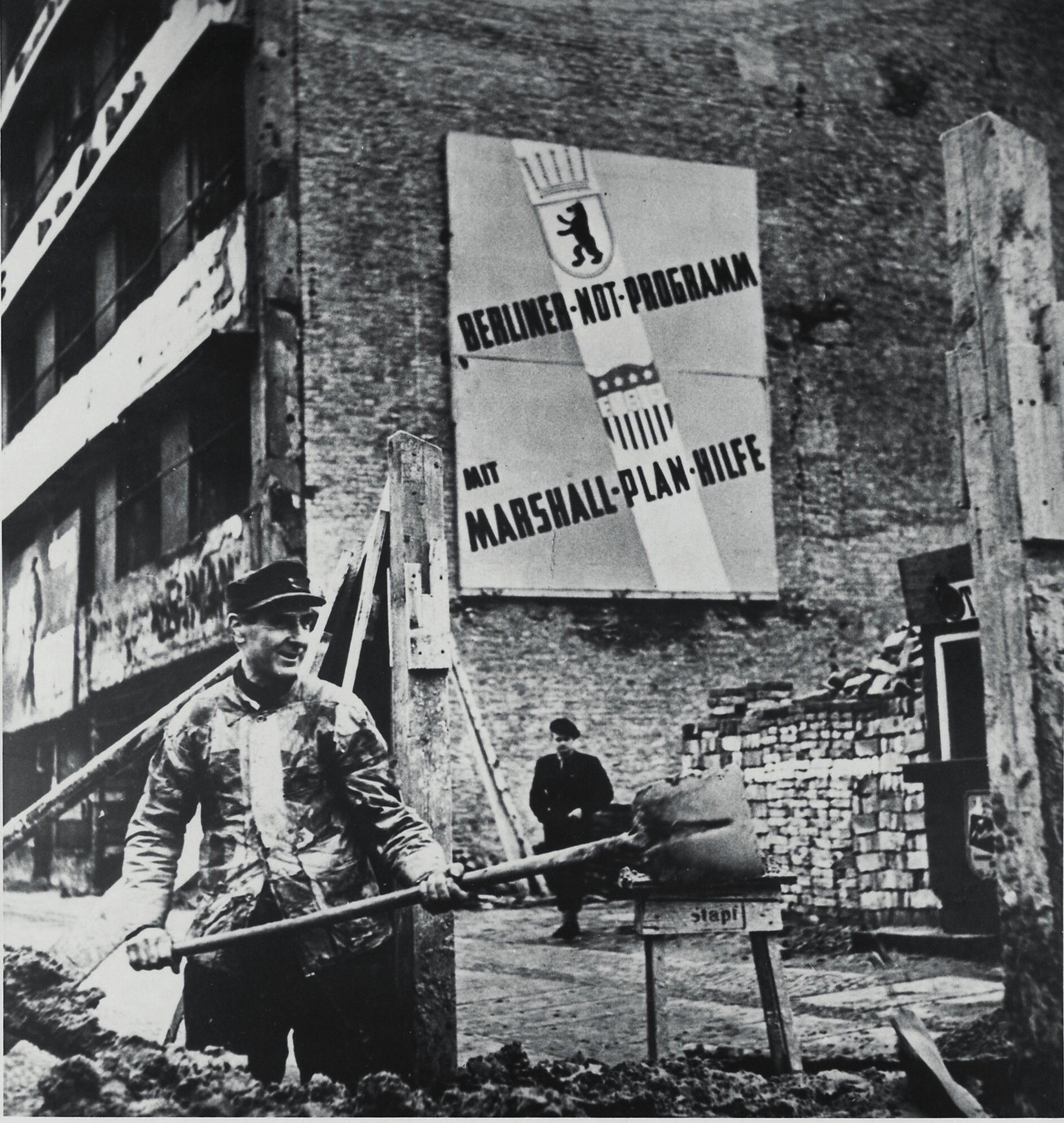
With the Marshall Plan, the USA promoted re-industrialization in Western Europe after 1945. However, the funds were only available when left-wing, communist, anti-fascist parties and nationalist politicians such as Charles de Gaulle were driven out of government. In Greece, the money only flowed when the US military bombed the anti-fascist liberation movement and reinstated the monarchy. The Marshall Plan primarily promoted the sale of US products, the pegging of currencies to the dollar, and the establishment of branches of leading corporations, banks and consulting firms from the USA, including Hollywood culture.
The German and European entrepreneurs and bankers, including those in occupied and militarily neutral Western, Northern, and Southern Europe, including Switzerland, as well as those from the USA itself, who were accomplices of the Nazi occupiers - they all went unpunished. This anti-communist policy was secured by hard power, by the US-led military alliance NATO, reinforced by an increasing number of US military bases in the growing number of NATO member states (Rügemer, 2024bRügemer, W. (2024). Occupation as a business model. Israel - global hotspot of the digital surveillance industry, Die Krähe (Vienna).).
In Western Europe, especially in the “Western showcase”, the provisional separate state of the Federal Republic of Germany, it was therefore not only the old wealth of Nazi collaborators that flourished. There was also increasing prosperity for large sections of the dependent workforce. However, this was only a temporary concession.
Eastern enlargement: dependent oligarch capitalism under NATO
From 1990 onwards, US advisors organized the de-industrialization of the ex-socialist states. McKinsey, Price Waterhouse Coopers and JP Morgan dominated the German Treuhand agency: the companies of the socialist GDR were sold at knock-down prices, downsized after a few years or even shut down. With the help of EU subsidies and World Bank loans, subsidiaries and suppliers of Western corporations replaced the old industry - wages are still lower than in West Germany, unemployment is higher, even if it is mitigated by internal labor migration.
This is how the type of dependent oligarch capitalism was established in the ex-socialist states of Eastern Europe: Foreign corporations - primarily in the automotive, energy, logistics, trade and pharmaceutical industries - selectively use the locations for supplier companies or branches. Governments waive taxes and finance infrastructure. The EU grants subsidies without imposing conditions on workers’ rights. Wages are low and trade unions are deliberately weakened. Western banks, consultants and supermarkets are entrenched. Strategic decisions are made abroad. At the same time, local oligarchs form private-state monopolies. Up to a quarter of the working population have emigrated or are employed as cheap migrant workers in the rich West, seasonally or permanently, in construction, in private households, in home care, in hospitals and old people’s homes, in logistics and prostitution.
Politically, this is carried out - as with the Marshall Plan and NATO - by right-wing governments of various stripes, be they conservative, liberal or even social democratic. In Yugoslavia, NATO and the EU promoted nationalist, racist and right-wing radical to fascist forces and thus the nationalist division into six small states although nationalism is denounced by the same ruling forces in the West (Rügemer, 2022bRügemer, W. (2022). Deadly fracking.).
The USA also prioritized the military in the eastward expansion - for the further march towards Russia. All Eastern European states first became members of NATO, only then were they allowed to join the EU - there was no exception. The USA set up additional US military bases in particularly anti-Russian states such as Poland and the Baltic states. The USA also ensured the separation of the Kosovo region from Serbia, leaving it impoverished, but now operates the largest US military base in Eastern Europe here. Other poor Eastern European states are already members of NATO, such as North Macedonia, Montenegro and Albania, without any prospect of becoming EU members in the foreseeable future. They are and will remain economically impoverished, important only as military bases against Russia.
Only Russia resisted the US-led deindustrialization
Initially, this strategy also worked against the most important US target state, Russia: the first pro-Western, corrupt president after 1990, Boris Yeltsin, promoted the sell-off of companies with the help of Western investors and consultants and Western-sponsored, local oligarchs. The national economy shrank, the population became impoverished, suicides and alcohol consumption increased.
Putin became the leading figure of resistance: although capitalism was not abolished, it was and has been shaped according to national interests since the beginning of the new millennium. Some oligarchs have joined in, some have moved their headquarters to London or Israel. The Russian economy recovered, NATO stayed outside: Russia became a seditionist enemy of the western system - although the earlier justification of evil “communism” is completely unfounded.
Conclusion: since the Marshall Plan and the founding of NATO, the USA has by no means wanted to spread the “free market economy” and capitalism, but only a selective location policy for Western investors, not economic development. Moreover, this is doubly secured militarily, through NATO membership and additional US military bases - and politically it is carried out with the help of right-wing political forces.
Western Europe: Dependent parliamentary capitalism
Since the First World War, and significantly expanded since the Second World War, US corporations, banks and consultants have operated branches in Western Europe, such as Coca Cola, Ford, Goodyear, General Electric, IBM, Dow, Esso, Procter & Gamble, UPS, McDonald’s, JP Morgan, McKinsey. The new US digital and platform companies such as Apple, Microsoft, Google, Amazon, Facebook and Uber and US consulting firms such as Accenture and Freshfields now also operate branches in European countries with leading positions in their sectors.
But since the turn of the millennium, a new practice has emerged: the new, deregulated US capital players, which are still officially considered “shadow banks”, are buying existing companies in Europe. Private equity investors such as Blackstone and Katch Investment Group (KKR) (“locusts”) specialize in medium-sized, unlisted companies. “Europe is the best market in the world for us,” said Stephen Schwarzman, head of the largest private equity investor Blackstone, after the annual Super Return International, the meeting of 5,000 private equity managers in Berlin in 2024 (Handelsblatt, 2024bHandelsblatt. (2024). JP Morgan doubles number of clients in the German SME sector.).
And the first US capitalist league with BlackRock & Co. made their entry into the EU with the help of the “financial crisis” of 2008. BlackRock, Vanguard, State Street, Capital Group, Fidelity & Co. are now the leading owners of the most important companies and banks in Germany, France, Belgium, Luxembourg, the UK, the Netherlands and, incidentally, Switzerland. For example, they are represented in all 40 stock corporations in the leading German share index DAX, in varying compositions (Rügemer, 2019Rügemer, W. (2019). The Capitalists of the 21st Century, Hamburg.).
The strategic decisions - restructuring, sale of parts of the company, job cuts, relocations abroad - are mainly made in the USA, in consultation with the European Commission. Most of the profits go to the USA, while the Americanization of working conditions (job patterns, gig working, working poor) is causing real wages to fall throughout the EU (HBF, 2024HBF. (2024). Real wages in the EU well below pre-crisis level.).
As a result, the EU’s share of global GDP has fallen from its former peak of around 25% to 15%, while the USA’s share has since risen back to its former level of 25%. This is why the head of Italy’s largest company, ENI (oil and energy), Emma Marcegallia, warned ahead of the G7 meeting in 2024: “If we carry on like this, we will not be able to maintain our welfare state, we will fail in the face of technological leaps and we will lose our quality of life” (FAZ, 2024bFAZ. (2024). A protection that nobody wants. Why the German car industry rejects punitive tariffs on Chinese imports.).
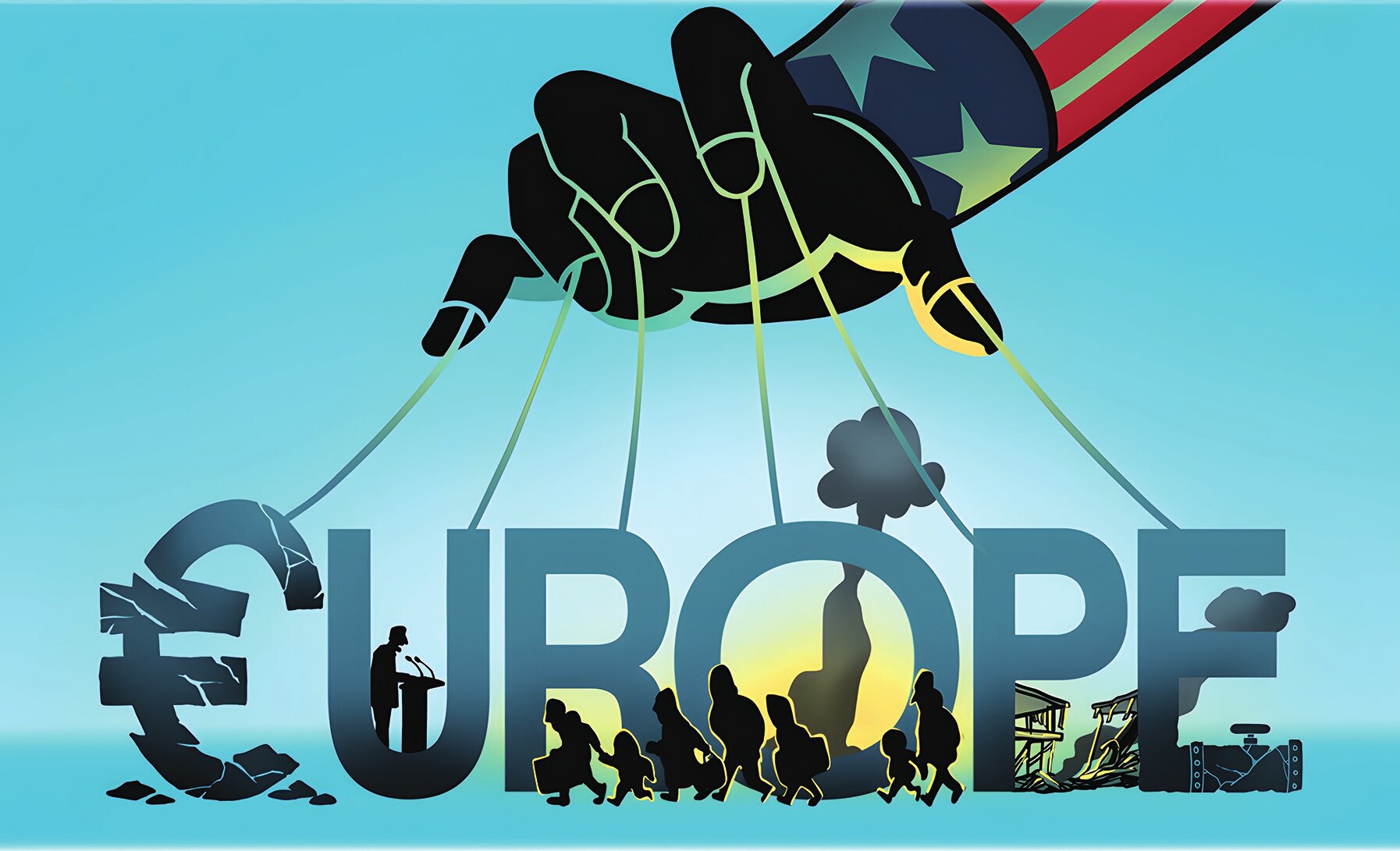
This is politically promoted and implemented in traditional parliamentary democracies: but they are subject to NATO, the EU and corporate decisions subject to BlackRock & Co. Governments and the European Commission are advised by US firms such as McKinsey, Accenture, KPMG, PwC, EY, Freshfields, White & Case, Standard & Poor’s and Morgan Stanley. Example for Germany: In addition to this highly remunerated consultancy, at least 179 ex-employees of these firms were employed as highly paid staff in the German Federal Chancellery, federal ministries and federal authorities in 2022 (DS, 2022DS. (2022). Federal government spends 580 million euros on consultants.). In the German Ministry of Economic Affairs under the Green Minister Robert Habeck, a BlackRock manager from London was appointed head of the policy department. PwC was installed in this ministry as the official auditing authority: US consultants decide on government subsidies to companies in energy design (PwC, 2023PwC. (2023). How Habeck’s house makes a consulting firm happy, Die Zeit.). Thus, European governments are acting ever more authoritatively in the interests of US capital.
This is why the parties in power for decades since the end of the Second World War - whether labeled as conservative, Christian, liberal, social democratic - have, accelerated since the turn of the millennium, impoverished the majorities of dependent employees, have continued to lose voter support, have promoted the strengthening of new right-wing forces: This applies to all leading capitalist states, the USA first and foremost, to the UK, France, Germany, Italy, the Benelux and Scandinavian states, and incidentally also to closely allied Israel.
“America First” energy policy since President Obama
The US government under President Barack Obama was advised by BlackRock during the financial crisis and promoted the international expansion of shadow banks. At the same time, Obama promoted and subsidized US fracked gas and turned it into a geopolitical weapon, especially against Russia. It is extremely harmful to the environment and is also deadly for local residents: they die earlier, as a longterm study by Harvard University found (Li, 2022Li, L. (2022). Exposure to unconventional oil and gas development and all-cause mortality in Medicare beneficiaries, Nature Energy.). Nevertheless, the USA became the world’s largest exporter. Under Obama, this fracking gas was also given a green makeover: he had the gas, which had been discredited as environmentally harmful, renamed “natural” gas, liquefied natural gas (LNG). In this way, green parties and green investment funds are also taking part in military-backed geopolitics (Rügemer, 2022Rügemer, W. (2022). Deadly fracking.).
The EU under Commission President Jean- Claude Juncker agreed the long-term purchase of LNG with the US government already under Donald Trump back in 2018. However, it was not until the war in Ukraine that the US fully achieved its goals: 1. cut the EU off from Russian gas and make it dependent on the much more expensive LNG, 2. additionally commit the EU states to even higher war budgets, against Russia and China. With the European Defense Industry Programme (EDIP), the European Union is subsidizing at least 50 percent of the weapons procured for its own military to be “Made in Europe” by 2030.
The European Commission as capital bureaucracy also accepted the two US laws of 2022 on the reindustrialization of the USA without criticism: The Inflation Reduction Act (IRA) as well as the CHIPS and Science Act. The USA is thus also subsidizing relocations from the EU, i.e. the de-industrialization of EU member states.
Germany: de-industrialization - and reindustrialization
Energy-intensive chemical companies are closing departments in Germany. Bayer is relocating mainly to the USA. BASF is spending 10 billion euros to expand its existing large site in China - where the chemical companies Covestro and Wacker are also expanding their production. The most successful German heating manufacturer, Viessmann, was bought by its US competitor Carrier. The leading confectionery manufacturer Haribo is relocating a large part of its production to the USA. Medium-sized companies are being bought by US “locusts” or are closing down. The number of insolvencies of small SMEs has risen steadily in recent years (Tagesschau, 2024Tagesschau. (2024). Bridge renovation will be more expensive than expected.). The bank JP Morgan, which has an expanded branch in Germany, has doubled its clients in the German SME sector since 2022 and arranges outsourcing to the USA (Handelsblatt, 2024Handelsblatt. (2024). JP Morgan doubles number of clients in the German SME sector.). US consultants dominate the arrangement of acquisitions and restructurings (Rügemer, 2023aRügemer, W. (2023). Expropriate Black Rock & Co. 3rd edition, Frankfurt.).
The two German industrial sectors that have long been international leaders are shrinking: German car manufacturers are still surviving by producing and selling luxury cars, in the USA and especially in China; automotive suppliers are being outsourced to the USA, Hungary, Slovakia or China, or they are closing down if they cannot keep up with e-mobility. And mechanical and plant engineering is increasingly lagging behind technologically, even compared to China (PwC, 2024PwC. (2024). German mechanical engineering on a downward spiral. PwC press release, Frankfurt.).
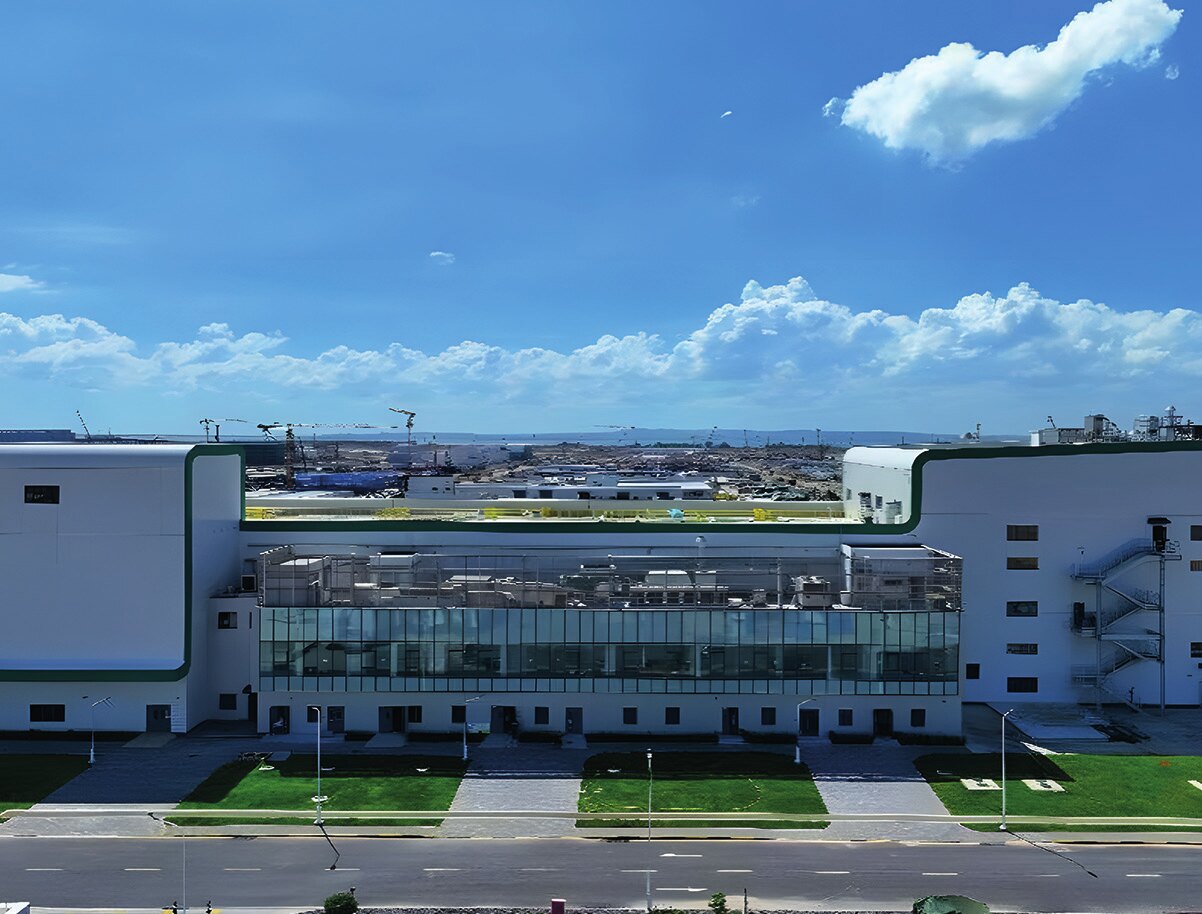
But the re-industrialization of Germany is also under US control. Apple, Google, Microsoft & Co. are increasingly taking over the digitalization of companies, finance, trade, media, education, healthcare, infrastructure and public authorities. Google is leading the way with transatlantic submarine cables. Apple and Microsoft are building new data centers in Germany (FAZ, 2024aFAZ. (2024). A protection that nobody wants. Why the German car industry rejects punitive tariffs on Chinese imports.). The pharmaceutical company Eli Lilly is building a new factory in the Rhineland-Palatinate region, which is dotted with US military bases. Intel is building the largest chip factory in Europe in structurally weak eastern Germany - 10 billion euros in subsidies have been agreed: The subsidies come from all state and supranational budgets, from the EU in Brussels, from the German government in Berlin, from the regional state government of Saxony-Anhalt and from the city of Magdeburg. At the same time, Intel is also constructing subsidized new chip factories in Poland and Israel (Rügemer, 2024: 19Rügemer, W. (2024). Occupation as a business model. Israel - global hotspot of the digital surveillance industry, Die Krähe (Vienna).).
The largest chip manufacturer in the world, TSMC from Taiwan, is also building a subsidized chip factory in previously de-industrialized, poor East Germany. Tesla has built by far the largest, highly subsidized factory for e-cars in Germany and wants to expand further, also in eastern Germany (NYT, 2023NYT. (2023). Teslawants to double size of plant near Berlin.). The US chip manufacturer Wolfspeed is building a chip factory in Saarland, a traditional industrial region whose steelworks have long since closed.
At the same time, Germany’s basic industrial structures remain at the level of poor developing countries: The state-owned railroad company Deutsche Bahn has too few rails, signal boxes and electrical overhead lines are in extreme need of repair - train cancellations and delays are part of the daily experience of millions of customers. 10,000 bridges, most of which date back to the post-war period, are in need of renovation, but only a few dozen are being painstakingly renovated in procedures that take years (Tagesschau, 2024Tagesschau. (2024). Bridge renovation will be more expensive than expected.). Despite decades of searching, no final storage site has been found for nuclear waste; the 16 interim storage facilities, some of which are in dilapidated former mines, are partly unauthorized (Energiezukunft, 2020Energiezukunft. (2020). No solution for the Asse interim storage facility. Retrieved June 15, 2024, from Energiezukunft.eu/zmweltschutz/gefaehrliche-deutsche-zwischenlager.).
BlackRock as coordinator for the “reconstruction” of Ukraine
BlackRock&Co. are among the leading shareholders in these US companies, as well as in TSMC and the 40 German DAX companies. Re-industrialization under US dominance also includes armaments. For example, the largest armaments company in Germany, Rheinmetall, which has expanded particularly strongly in recent years, is now under US control after 150 years of German tradition: the largest shareholder is now BlackRock, followed by Bank of America and Goldman Sachs.
Whether de-industrialized or re-industrialized, before the war, during the war and even after the war: US shareholders are reaping the high profits. BlackRock is also coordinating the reconstruction of Ukraine: according to CEO Lawrence Fink, it is to be digitized and de-bureaucratized to become a “beacon for the power of capitalism” (Wirtschaftswoche, 2023Wirtschaftswoche. (2023). The trillion-euro plan for Ukraine.). The more that is destroyed beforehand for the benefit of BlackRock shareholders - BlackRock is one of the leading shareholders in the US arms, energy, digital and fracking industries - the more lucrative the re-industrialization of Ukraine will be.
And the war budgets of the European NATO states are impoverishing the dependent workforce even more: working conditions are being made even more flexible, cheaper and disenfranchised - older workers are being eliminated prematurely; more and more overtime is not being paid. Young, willing skilled workers are no longer being brought in primarily from poor Eastern Europe, but from even poorer third countries such as India, Argentina and Morocco. Food, energy, rents, mobility, medical treatment and retirement homes are becoming more expensive, pensions are being lowered and privatized, and life expectancy is falling (DPWV, 2024DPWV. (2024). German Parity Welfare Association: Joint Poverty Report, Berlin.). This is also affecting the middle class, which has been pampered for decades as systemically relevant, in the USA for three decades, in the rich EU states with a delay of a few years.
At the same time, the new upstarts in the wake of the deregulated shadow banks, together with their civilian private army of advisors, their political accomplices and their “new values” of egoistic ego-staging, are acquiring new, elitist wealth. BlackRock & Co. anonymize their super-rich financiers with the help of letterbox companies in a dozen financial havens between the Cayman Islands, Luxembourg and Amsterdam, thus impoverishing the Western states, which are becoming increasingly over-indebted, including through more and more shadow budgets, with no prospect of regular repayment - the USA first and foremost: the leading capitalists demand and receive unprecedentedly high state subsidies, and at the same time industry and income for the majority of the population are shrinking, public infrastructure is being dismantled and made more expensive.
How Europe must save itself
The logic illustrated by Germany is proliferating in a weakened and different form throughout the EU. At the same time, previous shifts are continuing: Western European automotive suppliers are investing even more than before in Poland and Hungary. Open contradictions are emerging, both economically and politically: German car manufacturers VW, BMW and Daimler are rejecting the EU’s planned punitive tariffs on Chinese imports (FAZ, 2024FAZ. (2024). A protection that nobody wants. Why the German car industry rejects punitive tariffs on Chinese imports.). Spain, France and Belgium are importing gas from Russia. China is building a battery factory in Hungary. Serbia decided on a community of destiny and a free trade agreement with China in 2024 and is cooperating even more with Chinese investors, and China is building the rail link between the capitals of Budapest and Belgrade. Spain, Ireland and Norway recognize Palestine as a separate state. Hungary under Prime Minister Viktor Orban is negotiating with Ukraine, Russia and China about the possibility of a ceasefire in Ukraine against the EU’s leadership (Al Jazeera, 2024Al Jazeera. (2024). Hungary’s Orban meets China’s Xi in mission to end Russia-Ukraine war.).
US and EU sanctions are being circumvented with increasing ingenuity. India has become the largest intermediary for sanctioned Russian energy. Russia’s economy is flourishing, in contrast to Germany in particular. After two years of Western sanctions, Russia overtook the USA as a gas supplier in Europe in mid-2024 (Financial Times, 2024Financial Times. (2024). Russia overtook US as gas supplier to Europe in May.). A revealing detail: In the factory abandoned by Daimler, skilled workers are now building Chinese cars, which are also technically better and also cheaper (Focus online, 2024Focus online. (2024). Russia builds China cars in German factory.).
With the recipe of the ex-banker and populist autocrat Macron, who has rightly plummeted in the polls, and his somewhat more moderate colleagues in other European governments, Europe would indeed die: Even more support for Ukraine’s hopeless proxy war against Russia, even more armament against China, even more adherence to Blackrock concepts such as the pension “reform” pushed through by Macron in an authoritarian manner and also against parliament - the young people in particular, who have recently been intensively courted by Macron and the other crashing governing parties, have nothing to expect from such policies.
Freedom, equality, brotherhood and sisterhood require something else. The shadow banks, BlackRock & Co. and their new monopolies must actually be regulated, unbundled, expropriated and transferred to common ownership. But so far, these are only isolated voices (Rügemer, 2023Rügemer, W. (2023). Expropriate Black Rock & Co. 3rd edition, Frankfurt.). But even the US-oriented European Council on Foreign Relations (ECFR) stated, after a year of war in Ukraine: “Europe as a US vassal - that is unwise for both sides”, and, according to ECFR: only the PR China wants to and can “reshape the international order, economically, diplomatically, militarily, technologically”; China is also “at the heart of many critical supply chains on which the US and its allies depend” (Policy Brief, 2023Policy Brief. (2023). European Council on Foreign Relations: The art of vassalization: How Russia’s war on Ukraine has transformed transatlantic relations.).
Whereby “China” does not only mean the state of China, but also the continental formats SCO (Asia), CELAC (Latin America), FOCAC (Africa), 14+1 (Eastern Europe) and above all BRICS: Brazil, Russia, India, China, South Africa with other states such as the UAE, Egypt, Iran - and all without Chinese military bases - in systemic logical contrast to the militarily accompanied, war-obsessed globalization according to the US model.
Even the Research Institute of German Entrepreneurs states that it was and is national sovereignty that has enabled China’s rise to become the most successful economy (IW-Report, 2024: 6IW-Report 30. (2024). Institute of German Business: Competitive pressure from China for German companies.). So: Germany, France, European Union - let’s go for sovereignty!