Introduction
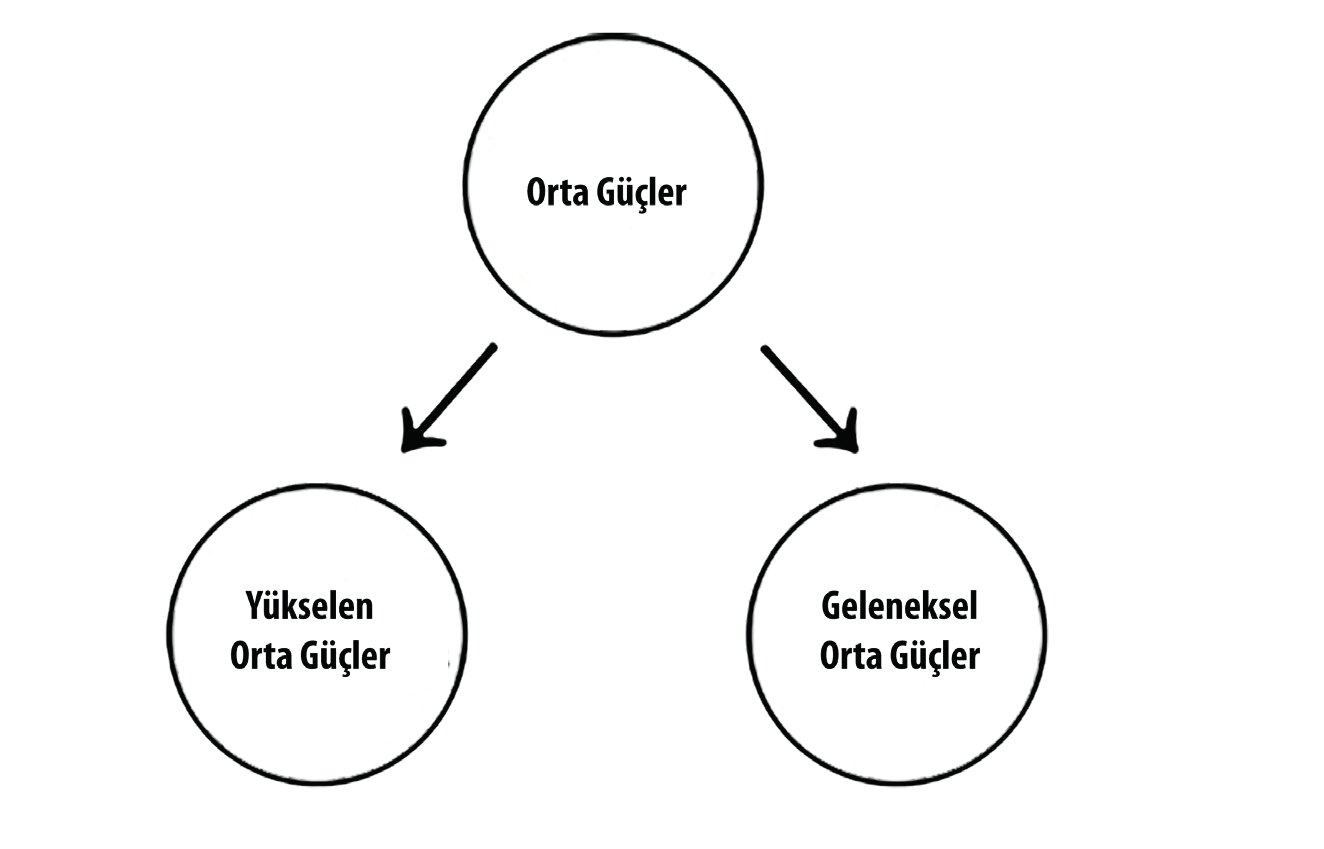
Middle powers denote nations that exhibit certain capabilities yet lack the capacity to rival the leading countries in the global hierarchy; they may have a considerable economic presence but do not hold a central role in worldwide industrial specialization. Currently, the dynamics of middle powers are shifting due to the transformation of the global political landscape, leading to a scenario where emerging middle powers such as Türkiye, India, Brazil, Mexico, Indonesia, and Saudi Arabia are experiencing significant developmental momentum, whereas traditional middle powers like Canada and Australia are witnessing a persistent decline in their influence in international affairs. In addition, alongside the big powers, the nations of the ‘Global South’ are augmenting their influence in the international sphere. There is an increasingly clear distinction between the two groups, which take different positions on world affairs. Furthermore, the divergent positions and tendencies of the two groups regarding foreign matters, including the quest for global discourse rights, the framing of international relations, and the rivalry among major countries, have further accentuated the gap. The Israeli-Palestinian conflict and the Ukrainian crisis have intensified the transformation of the worldwide political environment, while great power competition persists, and the international influence of the “Global South” continues to grow. In this process, the peculiar balancing diplomacy has rendered the position of emerging middle countries in the “Global South” bloc and international politics exceptionally significant. The world is currently undergoing a period of considerable turmoil in the international political landscape, with emerging issues consistently affecting global security and development. Emerging middle powers are employing balancing diplomacy through their rhetoric and actions, seeking diplomatic autonomy, serving as a “buffer zone” in the struggle among big powers, mitigating the intensity of that competition, and aiming to reduce uncertainty in global governance possibilities.
While middle powers have received some attention in the existing literature, many questions remain unanswered. The division among middle powers has not been comprehensively examined, leaving the motivations for emerging middle powers to pursue a non-aligned diplomatic approach, along with the implications of this diplomatic model, unaddressed (Edström & Westberg, 2020Edström & Westberg (2020). The source article does not provide a separate full bibliographic entry for this citation.). This paper will explore the implications of the emerging middle powers’ new role, examine the characteristics and performance of the balancing diplomacy they advocate, and conduct a thorough analysis of the causes and associated impacts of this diplomatic approach.
The Connotation of Emerging Middle Powers
Middle powers are not just essential actors that have surfaced in world politics in recent years but also represent states shaped by the combination of elements such as economic prowess, global influence, and geopolitical standing. Scholars exhibit considerable variance in their definitions of intermediate powers. One scholar posits that a country is classified as a middle power if it fulfills specific duties associated with that designation or perceives itself as such (Holbraad, 1971Holbraad, C. (1971). The Role of Middle Powers. Cooperation and Conflict, 6(2), 77–90). A scholar posits that the characteristic characteristics of middle powers include pursuing multilateral solutions to global challenges, adopting a conciliatory approach in international conflicts, and endorsing principles of responsible global citizenship (Cooper, 2013Cooper (2013). The source article does not provide a separate full bibliographic entry for this citation.). Some studies classify countries based on facts and quantification to examine the attributes of middle powers. For example, Kim, a South Korean academic employing a hierarchical framework, utilizes statistical indices to classify nations based on territorial size, GDP, trade volume, foreign currency reserves, population, and military personnel (Kim, 2009Kim, C(2009). Middle Power as a Unit of Analysis of International Relations: Its Conceptualization and Implications ( 국제정치분석 단위로서 중 견국가 ). Korean Journal of International Studies, (1), 7–36).
Current research on middle powers fails to account for the recent transformations within this group. The prior articles on middle powers focused on Canada, Australia, the Netherlands, and Sweden, positing that these nations served as supporters and stabilizers of the international order (Jordaan, 2003Jordaan, E. (2003). The concept of a middle power in international relations: distinguishing between emerging and traditional middle powers. Politikon, 30(1), 165–181). In recent years, the emergence of the “Global South” has led to a classification of middle powers into conventional middle powers, exemplified by Canada and Australia, and growing middle powers, represented by Türkiye, Indonesia, South Africa, and Brazil, among others.
The population size of emerging middle powers generally is substantial. As per the statistics data published by the World Population Review in 2024, India’s population stands at 1,450,940,000, securing the top position globally. Indonesia (283,488,000), Nigeria (232,679,000), Brazil (211,999,000), and Mexico (130,861,000) are rated 4th, 6th, 7th, and 11th globally, respectively (World Population Review, n.d.World Population Review. (n.d.). Total Population by Country 2024. World Population Review. Retrieved November 6, 2024 from). Countries like Türkiye and Saudi Arabia possess substantial Muslim populations, rendering them indispensable states in the Islamic world that warrant attention.
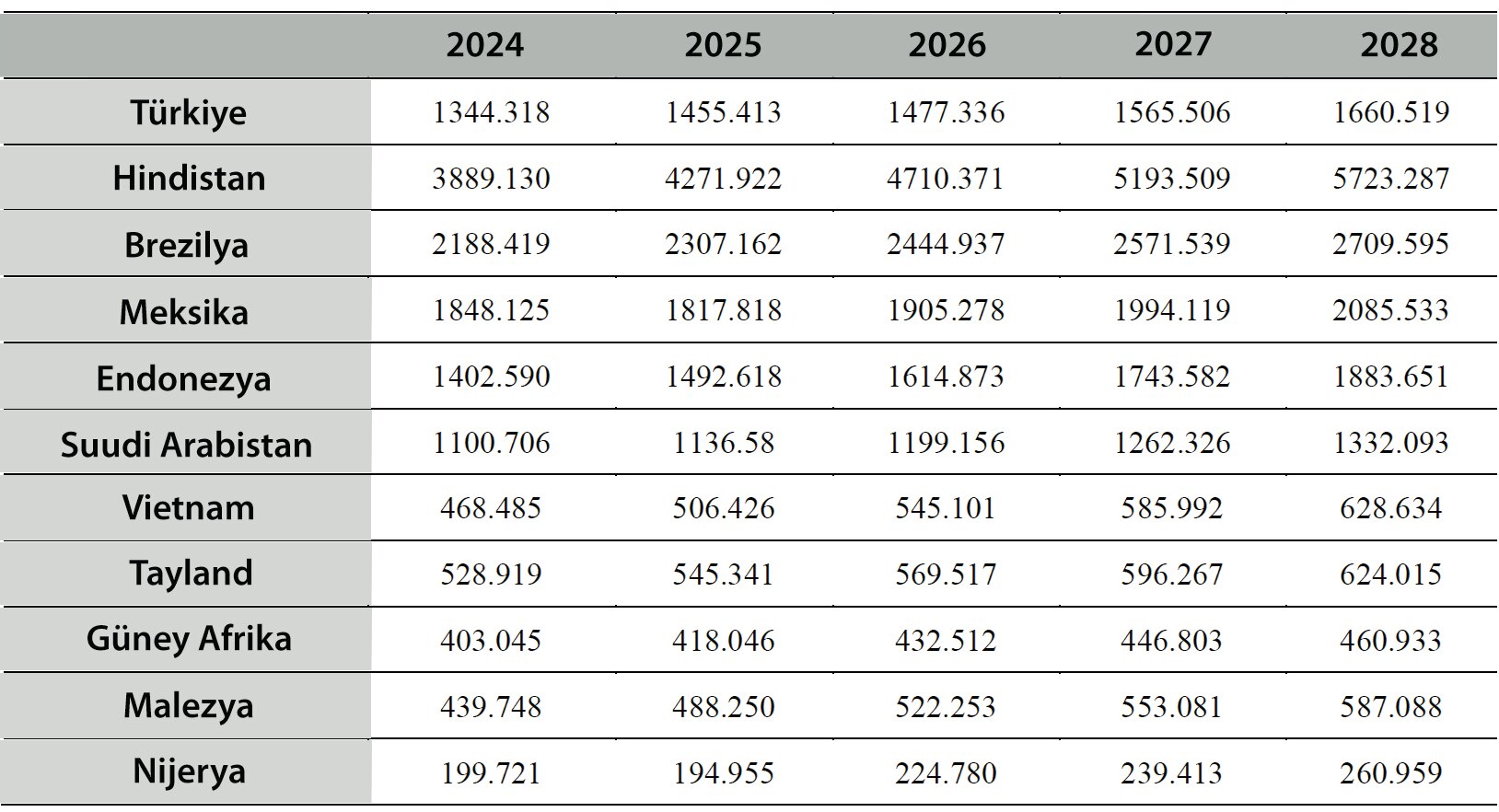
Concerning economic development, nearly all growing middle powers are classified as developing nations. However, they all exhibit a sustained growth rate, particularly in the economy. Emerging middle powers are evolving from “followers” in the globalization process to significant “leaders.” Middle powers exhibit significant ambition in actively engaging in the establishment of new regulations for the global economy. They progressively evolve as significant participants in international relations. They are no longer on the periphery of the world system but are continually advancing toward its center (Mittelman, 1995Mittelman, J. H. (1995). Rethinking the International Division of Labour in the Context of Globalisation. Third World Quarterly, 16(2), 273–296). The 2024 global GDP rankings and projections released by the International Monetary Fund (IMF) exemplify the remarkable performance of emerging middle powers. India’s GDP has exceeded that of the United Kingdom, while Brazil has also eclipsed nations such as Italy and Canada. Furthermore, economies like Türkiye, Indonesia, and Saudi Arabia have ascended into the global top 20.
Emerging middle powers wield distinct influence owing to geopolitical considerations and resource availability, and they typically adopt a proactive stance in international or regional matters. For example, Türkiye is positioned at the crossroads of other countries’ economic routes, which offers a crucial “lever” for Türkiye’s engagement in regional and global matters. It particularly affords Türkiye distinct advantages in competing against major nations in West Asia and the Middle East. Given Brazil’s strategic location, the United States has long viewed Latin America as its “backyard,” and the country is home to major ports that facilitate international transportation. It’s self-evident that the US provides convenience to Brazil in various aspects such as visas, investments, and tariff issues. Indonesia is considered the true leader of the Association of Southeast Asian Nations (ASEAN) and can exert asymmetric influence on transnational issues (Nabbs, 2020Nabbs, K. G. (2020). ASEAN Centrality and Indonesian Leadership in a Contested Indo-Pacific Order. Security Challenges, (3), 21–26). At the same time, Indonesia has one of the largest nickel reserves in the world. Nickel, as a critical mineral resource, is viewed as a critical mineral resource that can reshape the global new-energy battery material industry chain. Due to geopolitical factors and resource possession, emerging middle powers play an important and functional role in regional peace and development as well as security and governance issues. As a result, they have to be considered by major powers during the process of exerting influence on the region.
Balancing Diplomacy of Emerging Middle Powers
Emerging middle powers are increasingly significant actors in international affairs. In the context of competition and collaboration among major powers, emerging middle powers frequently employ a diplomatic strategy characterized by balancing diplomacy, which may be examined through three dimensions: international relations, organizations and institutions, and national strategy. These three tiers form a fundamental framework for balancing diplomacy. The execution of balancing diplomacy in international relations demonstrates the influence of growing middle powers and signifies their national goals. At the organizational and institutional level, multilateral diplomacy fosters an institutionalized network of connections, which provides emerging middle powers with external behavioral resilience. In the context of national strategy, it is manifested as a significant degree of autonomy, allowing foreign policy to embody the intentions of one’s own nation rather than those of others.
Firstly, regarding international relations. In March 2022, facilitated by Türkiye, the foreign ministers of Russia and Ukraine engaged in their inaugural direct communication since the onset of the Russia-Ukraine conflict. On July 22, both parties signed the “Ukraine Grain Security Transportation Initiative” in Istanbul, demonstrating Türkiye’s efforts to sustain equilibrium among all involved stakeholders (Yang, 2022Yang, C. (2022). Türkiye’s Balancing Diplomacy in the Russia-Ukraine Conflict: Performances, Motivations and Impacts. Arab World Studies, (5), 77-94). Another example: Saudi Arabia convened a peace conference, inviting 42 nations to engage in consultation and dialogue regarding the escalating Ukraine crisis (Sinem, 2023Sinem, C. (2023). The Jeddah Summit: Unveiling Saudi Diplomacy’s Objectives. Retrieved October 22, 2024 from).
In September 2023, Vietnam and the United States advanced their bilateral relations to a comprehensive strategic partnership (The White House, 2023The White House. (2023). Joint Leaders’ Statement: Elevating United States-Vietnam Relations to a Comprehensive Strategic Partnership. The White House. Retrieved October 15, 2024 from). Three months later, an agreement was established between China and Vietnam regarding the concept of a community with a shared future (Ministry of Foreign Affairs of The People’s Republic of China, 2023Ministry of Foreign Affairs of The People’s Republic of China. (2023). Building a China-Vietnam Community with a Shared Future. Retrieved October 18, 2024, from). In June 2024, Putin traveled to Vietnam to strengthen the comprehensive strategic partnership (The Vietnam Plus, 2024The Vietnam Plus. (2024). Vietnam, Russia determined to deepen comprehensive strategic partnership. The VietnamPlus. Retrieved October 19, 2024 from).
All of these reflect that emerging middle powers adopt a balancing diplomacy, building closer relationship networks with multiple countries while maintaining their existing non-aligned foreign policy. Emerging middle powers sustain multifaceted economic engagements grounded in a fact-based approach. Amidst economic and trade rivalry among major powers, these emerging middle powers have embraced a multilateral approach to economic engagement. While certain countries have enhanced their economic ties with the US, this does not equate to severing economic collaboration with China and Russia. India and Türkiye serve as pertinent examples.
India became a member of the “Indo-Pacific Economic Framework for Prosperity” (He & Luo, 2024He, X. Y. & Luo, Z. (2024). Content, Impact and China’s Response to the Supply Chain Agreements under the “Indo-Pacific Economic Framework”. International Trade, (9), 51-58) and joined the “India-Middle East-Europe Economic Corridor,” both proposed by the United States (Kumar & Vivek, 2024Kumar, A. & Vivek, N. D. (2024). India-Middle East-Europe Economic Corridor. The Diplomatist. Retrieved November 11, 2024 from). However, despite the economic sanctions imposed on Russia by the United States and European nations, as well as the ongoing Russia-Ukraine conflict, India continues to engage in trade cooperation with Russia concerning oil and industrial goods. Furthermore, according to calculations by Indian think tanks, in 2023- 2024, China constitutes 43.9% of India’s imports of electronic products, communication equipment, and electrical appliances (Xing, 2024Xing, W. (2024). Economic and trade cooperation between China and India: Achievements, problems and countermeasures. Northern Economy and Trade, (12), 32-37).
Turkey is actively collaborating with Russia in energy, trade, and investment, while also engaging extensively with China regarding the Belt and Road Initiative (BRI) and Turkey’s Middle Corridor initiative. The United States is currently implementing sanctions against Chinese companies, particularly in the technology and supply chain sectors; however, these emerging middle powers have neither adjusted to US policies nor emulated the actions of traditional middle powers. Emerging middle powers perceive China’s development as an opportunity; however, capitalizing on this opportunity does not entail forsaking investments from Western nations (Dai, 2016Dai (2016). The source article does not provide a separate full bibliographic entry for this citation.).
Secondly, regarding organizations and institutions. One of the highlights of balancing diplomacy is the multilateral institutional link between nations and international organizations. In contrast to conventional middle powers, emerging middle powers often demonstrate a heightened readiness to engage in regional or global agenda-setting. The institutional connections between nations and international organizations exemplify the diplomatic frameworks of emerging middle powers. For instance, to augment its influence in the “Global South” and expand its diplomatic reach, India consistently asserted its commitment to unifying the “Global South” and convened the Third Summit of the Voice of the “Global South” in August 2024, addressing regional conflicts, food and energy security, and offering “Indian solutions” to shared challenges (Ministry of External Affairs of India, 2024Ministry of External Affairs, Government of India. (2024). The 3rd Voice of Global South Summit 2024. Retrieved November 10, 2024 from). India utilized the G20 Summit to adopt the “New Delhi Declaration” opposing protectionism, which the Modi administration characterized as “historic and groundbreaking” (Paul, 2023Paul, R. (2023). Why G20 ‘Delhi Declaration’ Is Historic, Pathbreaking Leaders Explain. India News. Retrieved November 10, 2024 from).
Brazil primarily concentrates on three principal themes: combating hunger, poverty, and inequality; promoting sustainable development; and reforming global governance to augment its international influence in climate change and the transition to a green economy while advocating for the interests of “Global South” nations to foster greater international consensus (Zhou & Xia, 2024Zhou, Y. & Xia, S. Z. (2024). The Transition to Green Energy: Brazil’s Experience. Contemporary World, (19), 63-65).
Turkey is actively collaborating with international organizations and forming enduring cooperative partnerships. It has become a sectoral dialogue partner of ASEAN and created the Türkiye-ASEAN Joint Sector Cooperation Committee. Turkey is spearheading the Organization of Turkic States to enhance regional integration cooperation in Central Asia and has acquired the status of a dialogue partner within the Shanghai Cooperation Organization.
Ultimately, within the realm of national strategy, prioritizing independence and fostering comprehensive strategic cooperation with numerous countries serves as a fundamental principle to direct the external actions of emerging middle powers. On April 7, 2022, over 50 nations, including Western countries and Ukraine, requested at the Emergency Special Session of the United Nations General Assembly the temporary suspension of the Russian Federation’s membership in the Human Rights Council. Despite its significant economic and military collaboration with the United States, Saudi Arabia cast a dissenting vote (United Nations Digital Library System, 2022United Nations Digital Library System. (2022). Suspension of the Rights of Membership of the Russian Federation in the Human Rights Council: Resolution /Adopted by the General Assembly. United Nations Digital Library System. Retrieved November 11, 2024 from). Despite the West imposing economic sanctions on Russia, Türkiye, India, and Brazil declined to engage and maintained their economic and energy collaboration with Russia. Comparable circumstances exist in arms sales and military collaboration, with India, Indonesia, and Vietnam all enhancing their partnerships with the West. These military collaborations primarily focus on enhancing their defense capabilities rather than aligning with the U.S. to contain China and Russia through the reinforcement of the U.S. military alliance system.
Following the border tensions between China and India in 2020, the United States sought to leverage this incident for intervention. The Indian government contended that despite existing issues between India and China, it would refrain from seeking mediation from any third party (The New Indian Express, 2024The New Indian Express. (2024). India not looking at any third country to mediate on China. The New Indian Express. Retrieved November 13, 2024 from). Emerging middle powers aspire to act as stabilizers in conflicts, facilitate mediation among the parties involved, and strive to alleviate tensions rather than exacerbate them. As these and similar cases show, it can be said that emerging middle powers prioritize independence and pursue their national interests rather than emulate the actions of other nations.
The Motivations of Emerging Middle Powers’ Balancing Diplomacy
The transition of emerging middle powers towards a more autonomous and balanced diplomatic approach is driven by both subjective and material factors. It fundamentally arises from the need to protect national interests. Nevertheless, if these nations are unable to engage in negotiations with major powers, adopting this balancing diplomatic model may incur greater costs, potentially leading to economic recessions or jeopardizing national security. Furthermore, the world is experiencing unprecedented change, and the inequitable international order promoted by Western nations is steadily disintegrating, creating opportunities for a novel transformation of the international order. Emerging middle powers also engage in protectionism, neutrality, non-alignment diplomacy, and a commitment to multilateralism.
Primarily the necessity to safeguard national interests. From a cost-benefit analysis, the advantages of balancing diplomacy significantly outweigh the disadvantages. Balancing diplomacy can provide benefits in more than one dimension for national interests, which are the most important determinants in international relations. In economic collaboration, emerging middle powers can enhance economic growth and optimize benefits by maintaining trade relations with Western nations while participating in the BRI and BRICS initiatives. From the standpoint of sovereignty preservation, balancing diplomacy allows emerging middle powers to evade entanglement in conflicts between major powers, sustain strategic autonomy, reduce national strategic risks, and diminish reliance on a singular entity. By sustaining equitable relations with various entities, they can avert substantial losses resulting from strategic modifications by an individual nation or coalition. For example, India engages in diplomatic balancing between the United States and Russia. It acquires sophisticated military apparatus from Russia to ensure its military security and promote the stable advancement of its defense sector, while concurrently enhancing collaboration with the US in economic, technological, and military armaments (Yang, 2024Yang, L. (2024). Modi Government’s Military Diplomacy: Drivers, Trends and Implications. South Asian Studies, (1), 105-130). This strategy enables India to sustain a comparatively autonomous strategic stance between the US and Russia, with Türkiye serving as another illustration.
From the standpoint of domestic political stability, balancing diplomatic relations mitigates external interference in internal affairs. When a nation sustains favorable and equitable relations with various significant entities, it becomes challenging for external forces to exert unilateral pressure on its domestic politics, thereby enhancing the stability of the political environment and mitigating turmoil induced by excessive interference from a singular country, thus preserving peace and order within the state.
Secondly, emerging middle powers possess specific forms of “bargaining” capital. Implementing balancing diplomacy aims to protect national interests; however, if a country lacks the capital to negotiate or engage with major powers, the outcomes may not be as favorable as desired. Capital may derive from geopolitical factors, oil, minerals, and other natural resources pertinent to the stability of the global industrial chain and development issues, or serve as crucial strategic pivots for the foreign strategies of major powers. Acquiring one or more of these will enhance a nation’s negotiating power. In the intricate and dynamic international landscape, the interests and strategic priorities of nations are perpetually evolving. This “bargaining” strategy can enhance their ability to manage uncertainties and discern their critical points of interest amid the fluctuating dynamics of competition and cooperation among major powers. India, at the regional level, shares borders with neighboring countries like Afghanistan, Pakistan, and Sri Lanka, which are susceptible to significant issues. At the geopolitical level, the United States’ strategic emphasis is transitioning to the Asia-Pacific region (Guo, 2003Guo, X. G. (2003). The Shifting of US Global Strategic Priority. Chinese Journal of International Studies, (2), 17-22). India’s national strength ranks in the “first tier” within South Asia, affording the nation an opportunity to capitalize on its role and relationships with various major powers to augment its political discourse and bargaining power.
The evolution of the international relations landscape acts as a catalyst. It is an unavoidable historical trend for emerging middle powers to adopt balancing diplomacy. Influenced by a “Cold War mentality,” the United States perceives China as its foremost competitor and the principal impediment to the liberal international order (Sun, 2024Sun, Y. Y. (2024). Reshaping the industrial chain under the strategic competition between China and the United States. Industrial Innovation, (20), 7-9). Ultimately, the inherent structural contradiction between China and America is challenging to resolve and is improbable to escalate to the extent of warfare (Scobell, 2020Scobell, A. (2020). Constructing a U.S.-China Rivalry in the Indo-Pacific and Beyond. Journal of Contemporary China, (127), 69–84). Emerging middle powers remain incapable of independently confronting major powers due to their limited capabilities; however, cultivating balanced relations with these major powers is a strategically advantageous approach compared to dependence on a single major power. Consequently, in light of alterations in the international strategic landscape, emerging middle powers are reassessing their current foreign relations, their standing and advantages within alliances, as well as their negotiating stances on a range of critical issues (Efstathopoulos, 2023Efstathopoulos (2023). The source article does not provide a separate full bibliographic entry for this citation.). Conversely, regarding the economic and monetary settlement system, the epoch of US dollar hegemony has concluded. The accumulation of US foreign debt, the increasing economic power of emerging market nations, and the trend towards multipolarity in the international monetary system are undermining the status of the US economy and eroding confidence in the US dollar as the world’s primary currency (Cohen, 2008Cohen (2008). The source article does not provide a separate full bibliographic entry for this citation.). Conversely, the swift advancement of emerging economies is reducing the disparity between these nations and European countries, which will instigate significant alterations in the global economic framework. The rule-making role of the Western economic powers will be diminished; consequently, they must engage in negotiation and compromise more with emerging economies and relinquish greater influence and authority in decision-making. Consequently, the beneficial influence of emerging middle powers in the domains of economy, trade, and finance on global economic growth will become increasingly evident.
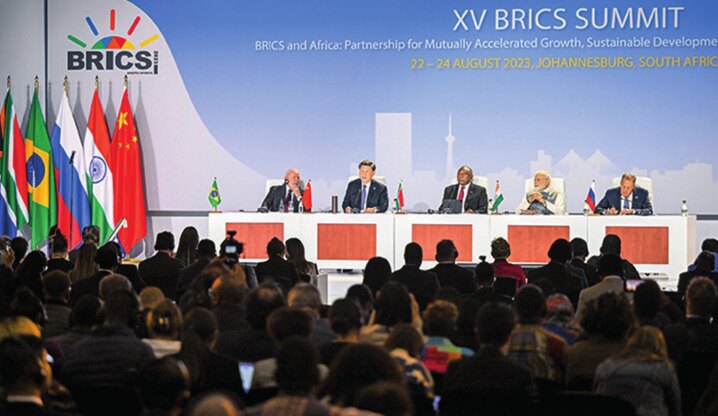
BRICS exemplifies the pursuit of reform within the global political and economic framework, primarily due to the significant imbalance in the current international institutional power structure, where the representation and influence of emerging and developing nations do not align with their economic stature (Huang & Song, 2024Huang, Z. & Song, X. L. (2024). Multi-alignment Diplomacy of Key Middle Countries. Modern International Relations, (9), 21-40). BRICS is perceived by emerging middle powers as a platform to reformulate the global order and redefine the rules of engagement in the pursuit of global political and economic multipolarity and systemic transformation (Lu, 2014Lu, J. (2014). The Meaning of the BRICS to the West—The Unavoidable “the Other” amid Changes and Speculation. Frontiers, (18), 53-63). This can be comprehended from two perspectives. BRICS enhances foreign policy alternatives for emerging economies and bolsters their diplomatic independence. Amid the escalating strategic rivalry among major powers and the collective emergence of the “Global South,” the tendency to take sides or participate in zero-sum games has diminished. Consequently, an increasing number of countries are able to pursue diversified cooperation avenues and diplomatic strategies aligned with their national interests and developmental requirements. Conversely, BRICS promotes the principles of non-alignment, prioritizes the welfare of the populace, and upholds open regionalism. Since the commencement of 2024, over 30 nations, including Malaysia, Kazakhstan, and Belarus, have expressed interest in joining the BRICS cooperation framework. These nations aim to identify and develop new economic growth opportunities, enhance the resilience and security of industrial and supply chains, and pursue a broader array of economic and political alternatives. They seek to mitigate the risks and challenges posed by geopolitical and economic fluctuations by expanding economic, trade, and investment collaboration with BRICS countries (Lin, 2024Lin, H. Y. (2024). BRICS Cooperation: International Institutional Innovation for Multilateral Cooperation in the New Era. Contemporary World, (11), 16-21). In the future, emerging middle powers can leverage the BRICS cooperation mechanism to enhance practical collaboration in finance, investment, energy, agriculture, and science and technology, in accordance with the United Nations 2030 Agenda for Sustainable Development. The BRICS organization enhances the resilience of emerging middle powers to risks and social development through mutual benefit and winwin outcomes.
The Implications of Emerging Middle Powers’ Balancing Diplomacy and China’s Responses
Emerging middle powers have become significant determinants influencing the trajectory of this century’s transformation. Their diplomatic balancing act consistently challenges the conventional international order and significantly alters the trajectory of the global landscape. Emerging middle powers possess significant ideological conflicts with the US, leading them to forge a distinctly divergent path from conventional middle powers. This unique diplomatic framework expedites the historical evolution of multilateralism, as the emergence of new great powers propels the global system into a phase of power rebalancing and redistribution. The reconfiguration of the global order increases the probability that emerging middle powers will undertake collective action (Stephen, 2013Stephen, M. (2013). The Concept and Role of Middle Powers during Global Rebalancing. Seton Hall Journal of Diplomacy and International Relations, 14(2), 36–52). Upon assessing the prevailing international circumstances, the US acknowledges that engaging these nations would entail substantial costs and yield limited efficacy (Chivvis & Geaghan, 2024Chivvis & Geaghan (2024). The source article does not provide a separate full bibliographic entry for this citation.). Matias Spektor, a professor of international relations in Brazil, stated, “We can never genuinely become an insider of the liberal international order” (Spektor, 2023Spektor, M. (2023). In Defense of the Fence Sitters. Foreign Affairs. Retrieved November 14, 2024 from).
Secondly, balancing diplomacy provides a “buffer zone” for competition among major powers. This strategic hedging can avert a resurgence of a Cold War and diminish the likelihood of destructive competition among major powers (Xue & Chen, 2022Xe, L. & Chen, Q. W. (2022). How to characterize and position medium-sized countries. China Development Observation, (5), 81-84). The contemporary ascent of emerging middle powers has established that the world cannot revert to the bipolar era characterized by the rivalry between the US and the Soviet Union, which lacked “middle forces” as a stabilizing factor. The epoch of hegemonic systems and bipolar frameworks, characterized by the dominance of a select few nations, has concluded (Liu & Wu, 2015Liu & Wu (2015). The source article does not provide a separate full bibliographic entry for this citation.). Currently, under the guidance of rising middle powers, the “Global South” possesses the capacity to counteract the hegemonic maneuvers of the United States, thereby altering the geopolitical landscape.
Finally, the fundamental stance of China towards emerging middle powers and their balanced diplomacy is a desire for peaceful coexistence with these nations, coupled with opposition to all forms of hegemonism and power politics. Furthermore, foreign policies and actions informed by the principles of balanced diplomacy should authentically represent the genuine aspirations of the people and more effectively serve the interests of each side, thereby contributing to the creation of a more harmonious global community and a shared future for humanity. China’s attitudes and reactions can be comprehended from both points of view and practical actions. Concerning the aforementioned, India, Türkiye, Indonesia, and Saudi Arabia are undertaking initiatives aligned with contemporary trends in regional and global peace and development matters. Simultaneously, these nations anticipate China to assume a more constructive role, while China will persist in adhering to the principles of “equality and mutual benefit,” “peaceful coexistence,” and “a community with a shared future for mankind” to foster a more peaceful and stable world. According to China’s government official statements and official documents, in collaboration with emerging middle powers, China will advance global sustainable development. President Xi emphasized that no matter how the development of China goes, it will not pursue hegemony, expansion, spheres of influence, or engage in an arms race. China will persist as a proponent of global peace, a contributor to international development, and a guardian of global order (The Central People’s Government of the People’s Republic of China, 2021The Central People’s Government of the People’s Republic of China. (2021). Xi Jinping: China will never seek hegemony, expand or seek sphere of influence. Retrieved October 24, 2024 from). China consistently upholds mutually advantageous and win-win cooperative relations in foreign affairs, collaborating with nations globally through three initiatives and offering public goods for global development. China is willing to engage in earnest dialogue with all nations, including emerging middle powers, to advance international relations and frameworks towards a more equitable and rational direction. As for practical actions, for instance, at the economic level, China does not forget to benefit others while developing itself. The execution of the BRI invites nations along the route to partake in developmental prospects. The annual Grand China International Import Expo invites global companies to capitalize on China’s market development opportunities.
China consistently endeavors to enhance the cohesion of the “Global South,” advocates genuine multilateralism, and offers peaceful resolutions to international disputes. China does not participate in any exclusive policies or alliances such as “small yard, high fence” or the “Five Eyes Alliance.” China engages in scientific and technological collaboration by conducting energy partnerships with Indonesia, establishing a joint space weather laboratory with Brazil, and advancing agricultural planting technologies internationally. China has created the Global Development and South-South Cooperation Fund, offering development assistance to over 160 countries, focusing on local education, healthcare, and infrastructure initiatives (Jiang, 2024Jiang, S. X. (2024). China’s Contributions to South- South Cooperation-In the Perspective of the “Global South”. Frontiers, (7), 82-94). Furthermore, China convened the Conference on Asian Civilizations Dialogue, the Forum of Ancient Civilizations, the China-Arab Relations Civilization Dialogue, the China-France Civilization Dialogue, and the China-Africa Civilization Dialogue Conference. China promotes the concept of “all flowers bloom together” and fosters mutual respect and learning among diverse civilizations.
Conclusion
It is essential to observe the distinctions among middle powers. In contrast to traditional middle powers that frequently adhere to the directives of major nations, emerging middle powers exhibit a heightened willingness to engage in international affairs and possess greater autonomy. Confronted with various global development issues and security challenges, emerging middle powers can offer innovative ideas and solutions to establish fairer and more rational global regulations, thereby advancing global governance towards a more equitable and just trajectory. Emerging middle powers employ balancing diplomacy and engage with various national and transnational actors, thereby becoming significant actors in international agendas.
Emerging middle powers have significantly endeavored to enhance the representativeness and inclusiveness of global governance. Nonetheless, as these nascent middle powers remain in a developmental stage, actions by external major powers may inevitably disrupt them. Furthermore, emerging middle powers exhibit discord on particular issues. Negotiating the conflict of interest remains a challenge. The alterations and modifications of the global landscape require time, and there will undoubtedly be disagreements in managing relations and interest disputes with major powers. Nonetheless, the long-term development prospects of emerging middle powers appear favorable. China will persist in enhancing mutual comprehension with emerging middle powers, broadening cooperative endeavors, fostering consensus, and endeavoring to assume a more significant role in advocating for the establishment of a more equitable and rational new international political and economic order.